Dr. Florence Murray: 54 Years of Dedication
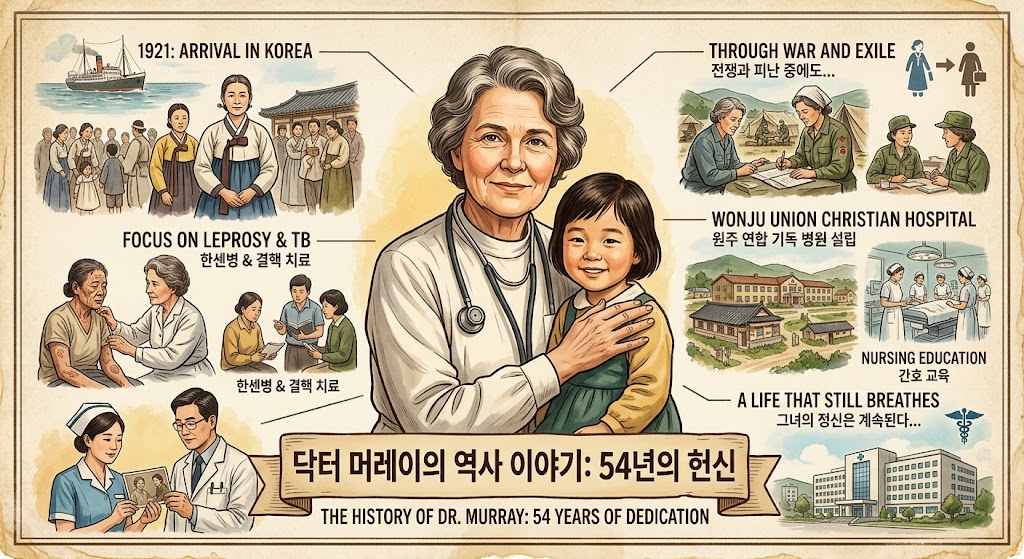
A Legacy of Healing: Dr. Florence Murray’s 54 Years of Dedication
The history of modern medicine in Korea is inextricably linked to the name Dr. Florence Jessie Murray (1894–1975). A Canadian medical missionary, her life was a 54-year odyssey of compassion, spanning colonial rule, the devastation of war, and the eventual rebirth of a nation.
1. The Call to the "Hermit Kingdom"
In 1921, Dr. Murray arrived in Korea under the United Church of Canada. She was stationed in Hamhung, South Hamgyong Province. At a time when medical infrastructure was almost non-existent for the local population, she became a pioneer in treating the most stigmatized illnesses:
- Hansen’s Disease (Leprosy): She provided medical care and community to those cast out by their families.
- Tuberculosis (TB): She fought the widespread "white plague" through early detection and sanatorium care.
- Women’s Health: She broke cultural barriers to provide gynecological care to women who previously had no access to doctors.
2. Faith Tested by Fire and War
Dr. Murray’s service was not a quiet one; it was interrupted by the greatest upheavals of the 20th century:
"I did not come to Korea to be a hero. I came to be a neighbor."
- World War II Exile: In 1942, she was forcibly deported by the Japanese colonial government. Despite this, she returned immediately in 1947.
- The Korean War (1950–1953): While others fled, she remained to treat refugees and wounded soldiers. She operated under the sound of artillery, often in makeshift tents and mobile clinics.
3. The Mother of Wonju Medicine
After the war, Dr. Murray moved to the Gangwon region, which had been decimated by conflict. Her most enduring physical legacy is the establishment of the Wonju Union Christian Hospital (now Yonsei University Wonju College of Medicine) in 1959.
She recognized that a hospital was only as good as its staff, so she founded a Nursing School to ensure that Korean professionals could eventually lead their own healthcare system.
4. Major Contributions at a Glance
| Category | Impact & Achievements |
|---|---|
| Years of Service | 54 years (1921–1975, including periods of exile/support). |
| Medical Focus | Leprosy, TB, Pediatrics, and Surgery. |
| Education | Trained the first generation of modern Korean surgeons and nurses. |
| Honors | Awarded the Mogran Medal (Order of Civil Merit) by the Korean government. |
Epilogue: A Spirit That Never Left
Dr. Murray retired to Canada in 1969, but her heart never left the peninsula. Upon her passing in 1975, she was remembered not just as a doctor, but as the "Blue-Eyed Mother of Korea." Her life reminds us that true healing involves staying through the darkness until the dawn arrives.