The Spirit of Goguryeo: General Eulji Mundeok and Military Science
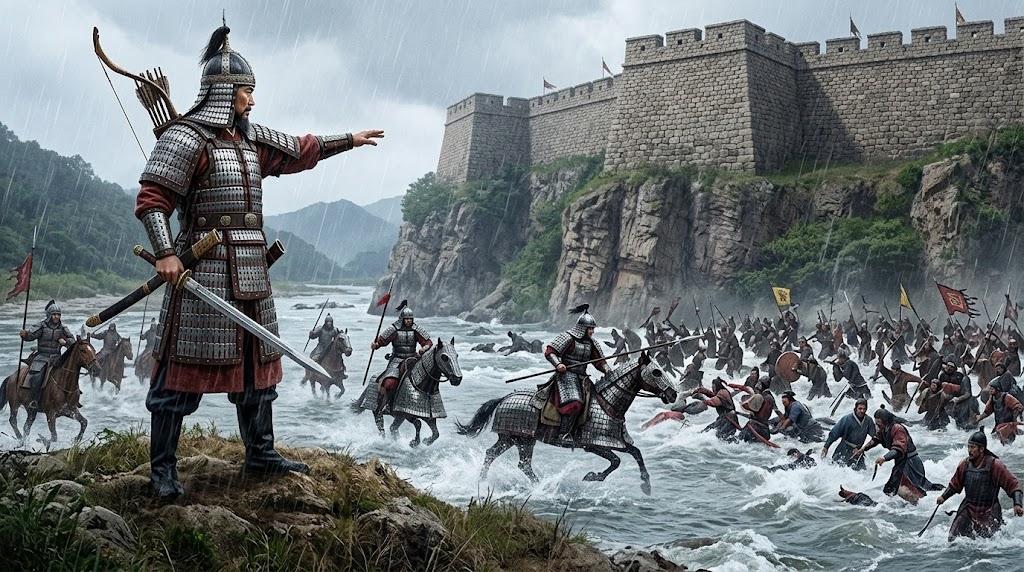
The Spirit of Goguryeo: General Eulji Mundeok and Invincible Military Science
The history of Goguryeo (37 BC – 668 AD) is a testament to the indomitable spirit of a kingdom that dominated Northeast Asia for over seven centuries. This "Spirit of Goguryeo" was characterized by a fierce sense of independence, unparalleled bravery, and a sophisticated application of military science that allowed it to repel even the largest imperial forces of the time.
1. The Tactical Genius: General Eulji Mundeok
At the pinnacle of Goguryeo’s military history stands General Eulji Mundeok. He is celebrated for his role in the Battle of Salsu (612 AD), where he faced the Sui Dynasty’s massive invasion force of 1.13 million soldiers.
Psychological Warfare
Eulji Mundeok did not rely solely on steel. He utilized psychological exhaustion, luring the Sui vanguard deep into Goguryeo territory while cutting off their supply lines. To mock the invading general, he sent a famous poem that demonstrated his confidence and strategic superiority:
"Your divine calculations have plumbed the heavens,
Your subtle plans have spanned the earth.
You have already won the battle and gained fame,
So I suggest you be content and depart."
The Salsu Ambush
As the Sui troops retreated across the Salsu River (modern-day Chongchon River), Eulji Mundeok ordered the destruction of a temporary dam he had built upstream. The resulting wall of water decimated the enemy ranks, leading to one of the most lopsided victories in world military history.
2. Invincible Military Science
Goguryeo’s victories were supported by advanced technology and engineering that were centuries ahead of their time.
A. Gaemamusa: The Iron-Clad Cavalry
The Gaemamusa were the elite heavy cavalry of Goguryeo. They represent a peak in ancient metallurgy:
- Full Body Protection: Both the rider and the horse were covered in lamellar armor consisting of thousands of small, overlapping iron plates.
- Mobility and Defense: Unlike solid plate armor, lamellar armor provided the flexibility needed for horseback combat while remaining virtually impenetrable to arrows and spears.
B. Advanced Fortress Engineering
Goguryeo was known as a "Kingdom of Fortresses." Their defensive structures were masterpieces of civil engineering:
- Interlocking Stone Masonry: Stones were carved into specific shapes to lock together without mortar, making the walls resistant to tremors and battering rams.
- Chi (Bastions): Protruding wall sections that allowed defenders to attack the enemy’s flanks as they approached the gate.
- Ongseong: Semi-circular secondary walls built around the main gate to trap attackers in a "kill zone."
C. The Macgung (Composite Bow)
Goguryeo archers were feared for their accuracy and power. They utilized a reflex composite bow made from wood, horn, and sinew. This design allowed for a compact bow that could be easily handled on horseback but possessed a much longer effective range and higher piercing power than the straight bows used by their rivals.
3. The Scorched Earth Policy (Cheong-ya Strategy)
Goguryeo’s military science extended to grand strategy. When faced with a numerically superior foe, they employed the Scorched Earth Policy. They would transport all food, livestock, and people into their impregnable mountain fortresses, leaving the invading army with nothing to forage in the harsh Manchurian and Korean landscape. This "starve and strike" tactic turned the environment itself into a weapon.
Conclusion
The legacy of General Eulji Mundeok and the military innovations of Goguryeo serve as a reminder that strength is born from a combination of unwavering spirit and scientific intelligence. By mastering the terrain, perfecting metallurgy, and outthinking their opponents, the people of Goguryeo ensured that their kingdom would be remembered as the "Grip of the East" for all time.