Republic of Korea Strategic Weapon: Hyunmoo-V Analysis Report
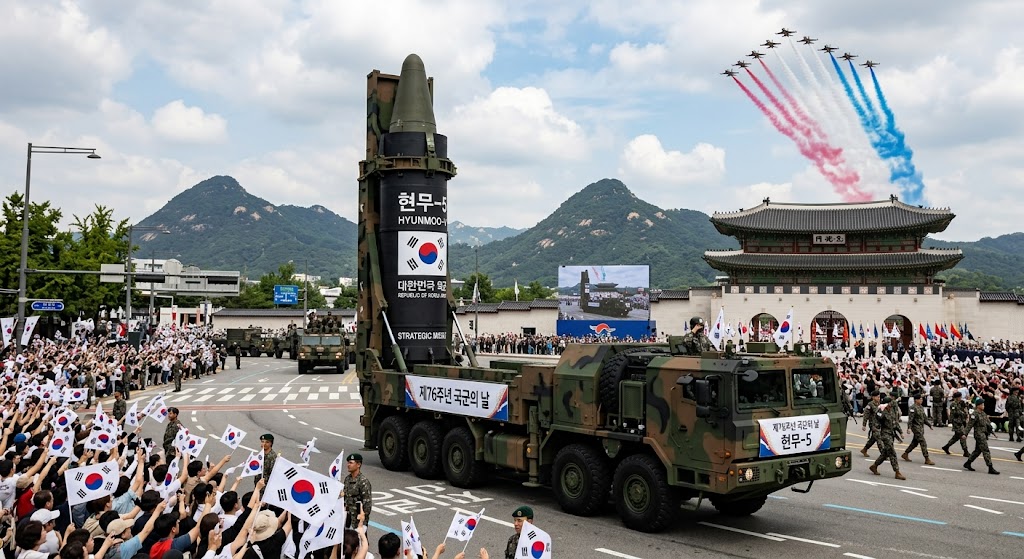
Hyunmoo-V (현무-5): The Apex of Strategic Deterrence
Republic of Korea's Indigenously Developed, World's Most Powerful Non-Nuclear Penetration Ballistic Missile
1. Unrivaled Technological Power
| Warhead Weight | 8-9 Tons (World's Largest). Possesses overwhelmingly superior destructive energy compared to existing conventional missiles. |
|---|---|
| Penetration Capability | Can penetrate over 100 meters of reinforced concrete and rock, neutralizing underground facilities. |
| Terminal Velocity | Descends at a speed of over Mach 10 in the terminal phase, making interception extremely difficult. |
| Strategic Versatility | By adjusting the warhead weight, the range can be extended by thousands of kilometers, allowing operation in the Intermediate-Range Ballistic Missile (IRBM) class. |
2. International Community and Regional Reactions
They analyze that "South Korea's missile technology has crossed the threshold." Military experts are stunned that a non-nuclear state can successfully operate a heavy-payload warhead of this level, highly evaluating South Korea's autonomous defense capability.
China is extremely sensitive to the Hyunmoo-V's extended-range capability. It considers the missile as a strategic threat capable of bringing its entire territory within range, and raises voices of caution against South Korea's military build-up.
Japan pays close attention to South Korea's precision-strike capability and uses it as a case study to justify its own "counterstrike capability." On the other hand, there is a perceptible sense of unease that South Korea's missile arsenal is already outpacing Japan's.
It poses a direct existential threat to North Korea's deeply concealed leadership. The massive warhead, using a vertical descent approach that is virtually impossible for any current air defense system to stop, serves as a practical counterparty to North Korea's asymmetric capabilities.
3. Conclusion: Strategic Implications
The deployment of the Hyunmoo-V signifies that the Republic of Korea no longer relies solely on the nuclear umbrella of its allies, but possesses the capability to establish an autonomous 'balance of terror'. This will serve as a key asset that amplifies South Korea's diplomatic and military voice in future regional dynamic shifts.