The Evolution of K-Defense: Shaping the Future of Global Security
The Evolution of K-Defense
Present Achievements and Future Horizons of the Korean Defense Industry
The South Korean defense industry, popularly known as "K-Defense," has undergone a radical transformation from a heavy reliance on foreign imports to becoming a major global exporter. In an era of shifting geopolitical alliances and supply chain vulnerabilities, South Korea has emerged as a "Strategic Partner for Global Security," offering reliable, high-performance military solutions to nations across Europe, the Middle East, and Southeast Asia.
1. Current Landscape: The Era of K-Defense Renaissance
South Korea currently ranks among the top defense exporters globally, with an ambitious goal to become one of the "Global Top 4" by 2027. This rapid ascent is not merely a result of market opportunity but is built upon decades of rigorous testing, mass production efficiency, and technological maturity.
The Three Pillars of Global Success
- Unrivaled Delivery Speed: While traditional Western suppliers often face long backlogs, South Korea’s highly active production lines allow for remarkably fast delivery schedules, meeting urgent security needs in record time.
- Exceptional Cost-Performance: K-Defense platforms offer high-tier technological capabilities—often fully compatible with NATO standards—at a more competitive price point and with higher operational availability than many alternatives.
- Total Lifecycle Support: Korea offers "Total Solutions," which include local manufacturing hubs, extensive technology transfer, and robust Maintenance, Repair, and Overhaul (MRO) packages to ensure long-term sovereignty for the purchasing nation.
Iconic Defense Platforms
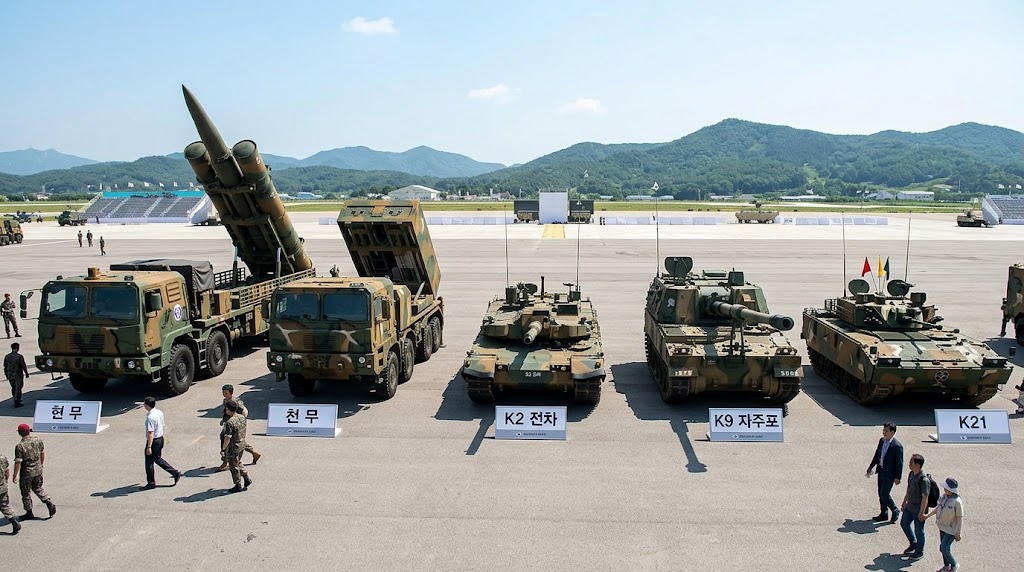
The success of K-Defense is anchored by a few "Best-in-Class" systems. The K9 Thunder Self-Propelled Howitzer currently dominates over 50% of the global tracked howitzer market. The K2 Black Panther Main Battle Tank is widely regarded as one of the most advanced tanks in production today, offering superior mobility and firepower. In the air, the FA-50 Fighting Eagle has proven itself as a versatile and reliable light combat aircraft, while the Cheongung-II (M-SAM) missile system has secured massive contracts in the Middle East, showcasing Korea's prowess in precision interceptor technology.
2. Future Horizons: "Defense 4.0" and the Tech Revolution
The future of K-Defense lies in the integration of Artificial Intelligence, robotics, and aerospace technology. As the nature of warfare shifts toward data-driven and unmanned operations, Korea is pivoting toward a "Defense 4.0" strategy.
Manned-Unmanned Teaming (MUM-T)
Addressing the challenge of shrinking demographics and the need for zero-casualty operations, Korea is prioritizing MUM-T. This involves the KF-21 Boramae fighter jet operating in conjunction with autonomous "Loyal Wingman" drones, and K2 tanks coordinating with unmanned ground vehicles (UGVs) for reconnaissance and fire support. This synergy maximizes combat effectiveness while significantly reducing risks to human personnel.
Expansion into Space and Cyber Domains
The battlefield is expanding into the final frontier. South Korea is aggressively developing its own low-earth orbit (LEO) reconnaissance satellite constellations to provide real-time intelligence. Furthermore, the development of Directed Energy Weapons (DEW), such as anti-drone laser systems, is positioning Korea at the forefront of neutralizing low-cost threats like UAV swarms with high precision and minimal cost-per-shot.
3. Strategic Challenges and Global Integration
To maintain this momentum and reach the "Top 4" status, several strategic hurdles must be overcome. The industry is currently focusing on "True Independence" and "Global Cooperation."
| Focus Area | Strategy & Objectives |
|---|---|
| Core Component Localization | Indigenizing high-tech components like aircraft engines and semiconductors to eliminate Export License (E/L) risks. |
| Global MRO Hubs | Establishing maintenance hubs in Europe (Poland), Australia, and the Middle East to provide real-time support. |
| U.S. Market Entry | Collaborating with U.S. prime contractors for major programs like the T-7 Replacement or naval MRO services. |
| AI & Quantum Integration | Investing in 8 core strategic technologies, including Quantum sensing and AI-based autonomous command and control. |
Conclusion: A Shield for Freedom
The future of K-Defense is not just about selling equipment; it is about building a collective shield for democratic values. By providing reliable and advanced technology to partners worldwide, South Korea is contributing to a more stable global security architecture.
From the historic legacy of the "Turtle Ships" to the modern marvel of the KF-21, the Korean defense industry remains committed to the principle of "Peace through Strength." As 2027 approaches, K-Defense stands ready to define the next generation of global military standards.