South Korea KAI KF-21 Boramae: Production Efficiency and International Expert Analysis
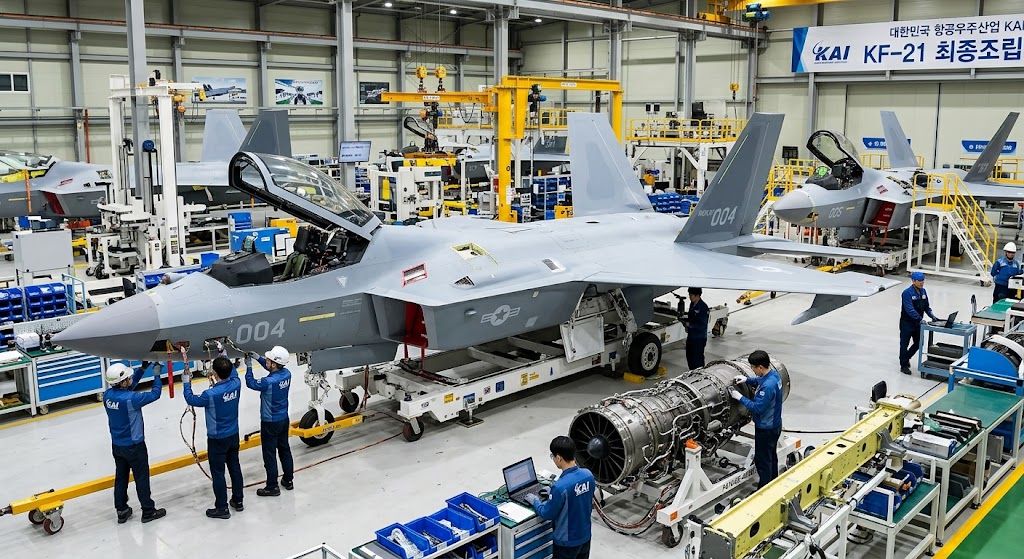
The KF-21 Boramae, the crown jewel of South Korea's aerospace industry, has successfully transitioned from its prototype flight-testing phase into robust mass production and operational deployment[cite: 2]. Developed under the leadership of Korea Aerospace Industries (KAI), the KF-21 entered the global defense market as a cutting-edge 4.5-generation fighter, engineered with an open architecture that allows it to evolve into a 5th-generation stealth platform[cite: 2]. This comprehensive report provides an in-depth analysis of the manufacturing innovations driving its production efficiency and evaluates how international defense experts view the aircraft's long-term market competitiveness[cite: 2].
1. Production Infrastructure and Manufacturing Innovations
In modern military aviation, production efficiency extends far beyond assembly line speeds[cite: 2]. It encompasses digital design integration, supply chain resilience, advanced automation, and Lifecycle Performance-Based Logistics (PBL)[cite: 2]. KAI has capitalized on South Korea's advanced commercial manufacturing ecosystem to establish a highly digitized, state-of-the-art "Smart Factory" specifically tailored for the KF-21[cite: 2].
1) Digital Twin and Advanced Factory Automation
KAI has integrated Digital Twin technology across the entire manufacturing pipeline[cite: 2]. By creating an exact virtual replica of both the factory floor and the aircraft's structural components, engineers simulate assembly tolerances and component routing before physical hardware is touched[cite: 2]. This has drastically lowered the rework rate—a traditional bottleneck in fighter jet manufacturing[cite: 2].
- Final Assembly Line (FAL) Automation: The use of automated precision drilling and robotic positioning systems ensures that structural mating is controlled down to micrometer tolerances[cite: 2]. This high degree of automation eliminates human error, ensures uniform structural integrity, and drastically minimizes assembly cycle times[cite: 2].
- Additive Manufacturing (3D Printing): KAI has utilized aerospace-grade 3D printing for geometrically complex internal brackets, environmental control system ducting, and specific structural fittings[cite: 2]. This reduces raw material waste by up to 80% compared to traditional subtractive milling and cuts component lead times by more than half[cite: 2].
2) Supply Chain Stability through High Localization
A crucial metric of defense manufacturing viability is mitigating supply chain vulnerabilities caused by reliance on foreign sub-contractors[cite: 2]. The KF-21 has systematically mitigated this risk by achieving a domestic localization rate target exceeding 65%[cite: 2].
- Indigenous Avionics Suite: Critical sub-systems—including the Active Electronically Scanned Array (AESA) radar, Infrared Search and Track (IRST), and the integrated Electronic Warfare (EW) suite—were developed domestically through collaboration with the Agency for Defense Development (ADD), Hanwha Systems, and LIG Nex1[cite: 2]. This indigenous ownership ensures that production schedules remain insulated from foreign Export License (E/L) delays[cite: 2].
- Enhanced Fleet Availability: High localization drastically streamlines Performance-Based Logistics (PBL)[cite: 2]. Because spare parts and technical updates are sourced locally, the Republic of Korea Air Force (ROKAF) and future export clients can expect superior fleet availability rates, hovering near 90%, which is remarkably high compared to legacy imported Western fighter platforms[cite: 2].
3) Economies of Scale and Output Scalability
KAI’s production lines in Sacheon are configured to deliver more than 20 airframes annually to meet the ROKAF's urgent requirement to phase out aging F-4 and F-5 fleets[cite: 2]. As initial production lots mature, the manufacturing learning curve is yielding shorter build hours per airframe[cite: 2]. This operational flexibility means the assembly line can scale up rapidly to accommodate foreign export orders without requiring costly structural overhauls to the factory floor[cite: 2].
2. Global Expert Perspectives and Defense Media Consensus
During the early phases of the KF-21's development, international defense publications (such as Janes Defence Weekly and Aviation Week) expressed profound skepticism regarding South Korea’s ability to deliver a clean-sheet, highly complex supersonic fighter within budget and on schedule[cite: 2]. However, following flawless test flights, successful supersonic transitions, and live-fire weapon separation milestones, the global expert consensus has shifted toward widespread acclaim[cite: 2].
| Analytical Domain | Global Expert & Media Consensus | Strategic / Market Implication |
|---|---|---|
| Evolutionary Roadmap (Block Strategy) |
By bypassing the high-risk hurdle of an internal weapons bay in Block 1 (utilizing semi-recessed hardpoints) and introducing it incrementally in Block 2/3, KAI reduced R&D risk and budget overruns significantly[cite: 2]. | Guaranteed on-time initial delivery to the military; technical maturity achieved progressively[cite: 2]. |
| Market Positioning & Value Proposition |
The F-35 is cost-prohibitive to acquire and maintain for many nations, while European 4.5-gen jets (Rafale, Typhoon) rely on older architectures and carry massive price tags. The KF-21 occupies a highly lucrative, modern, mid-tier sweet spot[cite: 2]. | Acts as an ideal, premium alternative for replacing global fleets of aging F-16s, F-5s, and Mirage jets[cite: 2]. |
| Low Observability (Radar Cross Section) |
The airframe boasts a distinct low-observable geometry heavily inspired by 5th-generation contours (resembling a scaled F-22). Even with external stores, its baseline RCS is demonstrably superior to legacy 4.5-generation aircraft[cite: 2]. | Provides high survivability in contested environments compared to older platforms[cite: 2]. |
| Weapon Systems Integration | The KF-21 is the first non-Western European platform to integrate the MBDA Meteor BVRAAM and IRIS-T, alongside compatibility with US ordnance and upcoming indigenous long-range air-to-surface missiles[cite: 2]. | Total independence over software source code allows custom weapon configurations for export buyers[cite: 2]. |
1) Positive Analysis: The 4.5-Generation "Game Changer"
Strategic think tanks, such as the RAND Corporation and the Center for Strategic and International Studies (CSIS), highlight that the KF-21’s primary competitive advantage is its modern, clean-sheet architecture[cite: 2]. While rivals like the F-16V or Rafale are fundamentally 1970s and 80s designs that have reached their geometric and power-generation upgrade ceilings, the KF-21 was designed from the ground up for the 21st century, boasting vast power reserves and modern data-bus configurations[cite: 2].
"The KF-21 will emerge as a premium alternative in the Indo-Pacific, Middle Eastern, and even European markets for nations that either find 5th-generation stealth platforms financially unviable or face political restrictions regarding American arms acquisitions. South Korea's highly reliable industrial base offers a value proposition that Western European manufacturers, plagued by slow production rates, simply cannot match."[cite: 2]
2) Critical Overviews and Structural Challenges
International observers also point out real-world geopolitical and technological hurdles that South Korea must navigate to ensure the platform's absolute market dominance[cite: 2].
- Dependency on Foreign Propulsion Tech: While the KF-21’s F414-GE-400K engines are assembled and localized by Hanwha Aerospace, the intellectual property remains anchored to General Electric (GE) in the United States[cite: 2]. Consequently, any prospective export sale requires a Third-Party Transfer Approval from the US government[cite: 2]. Aviation analysts note that this underscores the urgency for South Korea to accelerate its domestic 15,000-lbf class military gas-turbine engine development[cite: 2].
- Partner Country Volatility: The financial strain and shifting commitments displayed by Indonesia (the initial 20% co-development partner) introduced fiscal uncertainty early on[cite: 2]. However, experts note that the South Korean government’s decisive pivot toward self-funding the deficit and diversifying its export diplomacy has successfully insulated the core program from external turbulence[cite: 2].
3. Strategic Conclusion and Future Outlook
The KAI KF-21 Boramae stands as a powerful testament to South Korea's convergence of commercial high-tech prowess, precision heavy manufacturing, and unwavering defense resolve[cite: 2]. By utilizing digital twin simulation, robust factory automation, and an aggressive localization strategy, South Korea has delivered a highly cost-effective, premium military asset on a timeline that defies contemporary Western defense acquisition norms[cite: 2].
From an international standpoint, the KF-21 has redefined market dynamics[cite: 2]. It is not merely a replacement for aging national defense assets; it is a future-proof export architecture capable of Manned-Unmanned Teaming (MUM-T) with autonomous stealth loyal wingmen[cite: 2]. By demonstrating seamless, scalable mass-production capabilities, South Korea has solidified its trajectory toward becoming a top-tier global arms exporter, backed by one of the most operationally ready aerospace platforms of the decade[cite: 2].
```