The Eternal Guardian of the Boy King:
The Story of Eom Hong-do
Introduction: A Kingdom Divided
In the long and storied history of the Joseon Dynasty, few tales are as heartbreaking yet inspiring as the life and death of King Danjong, the sixth monarch. It is a narrative of betrayal, political ambition, and the ultimate loss of innocence. However, amidst the darkness of a bloody coup, the figure of Eom Hong-do (엄홍도) shines as a beacon of unwavering loyalty and human decency. His story is not one of high-ranking generals or powerful scholars, but of a low-level village official who chose "Uiri" (loyalty and justice) over life itself.
The Tragedy of King Danjong
King Danjong ascended the throne at the tender age of twelve. His reign was short-lived, eclipsed by the ambition of his uncle, Grand Prince Suyang. In 1455, Suyang staged a coup, forced his nephew to abdicate, and eventually declared himself King Sejo. Danjong was demoted to the rank of Prince Nosan and exiled to Yeongwol, a remote and rugged mountainous region in Gangwon Province.
Yeongwol was a natural prison, surrounded by the deep, swirling waters of the Donggang River and jagged limestone cliffs. It was here, in 1457, that the 17-year-old former king was eventually sentenced to death. On a cold autumn day, Danjong was executed—some say by poison, others say by strangulation—leaving behind a kingdom that was too terrified to mourn him.
The Decree of Terror
King Sejo, knowing that the memory of the young king could spark a rebellion, issued a chilling and absolute decree:
"The body of the deposed king shall be cast away. Anyone who retrieves, mourns, or buries the body shall be executed, and three generations of their family shall be wiped out."
This was the law of Yeonjwa-je (guilt-by-association). It meant that if one man showed mercy to Danjong, his parents, his children, and his grandchildren would all face the executioner’s blade. Consequently, the body of the young king was thrown into the river, and the residents of Yeongwol turned their eyes away in fear, leaving the royal remains to the elements.
Eom Hong-do: The Choice of a Commoner
At the time, Eom Hong-do held the modest position of Hojang (a village clerk or local administrative head) in Yeongwol. While he was a government official, his rank was low, and his influence was minimal. Yet, when he saw the body of the boy king floating abandoned in the cold waters of the Donggang, he was overcome with grief.
His family, sensing his intent, begged him to ignore the sight. "Think of your sons! Think of our family!" they cried. Eom Hong-do responded with words that would echo through Korean history: "How can a subject, who has lived under the grace of the king, ignore the tragic end of his monarch? Even if it means the destruction of my family, I cannot let my king rot in the water."
The Secret Burial and the Miracle of the Deer
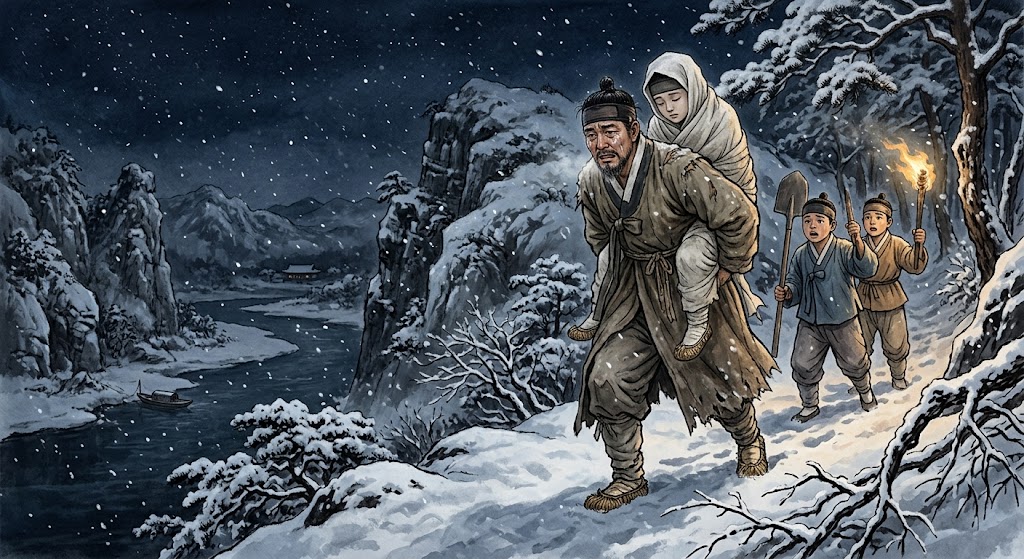
Under the cover of a pitch-black night, Eom Hong-do and his sons secretly paddled into the river. They retrieved the cold, waterlogged body of Danjong and wrapped it in a shroud Eom had prepared in secret. Carrying the king on his back, Eom began the grueling climb up the steep slopes of Mount Dongul.
It was the dead of winter, and the ground was frozen like stone. Eom Hong-do struggled to find a place where he could dig a grave without the noise of his tools alerting the authorities. Legend says that as he reached a certain height, he saw a deer lying calmly in the snow. As Eom approached, the deer vanished. In the exact spot where the animal had been resting, the snow had melted, and the earth was miraculously warm and soft.
Recognizing this as a sign from the Heavens, Eom Hong-do hurriedly buried the king. He offered a final bow and disappeared into the night. This humble grave would eventually become Jangneung, the official royal tomb recognized centuries later.
A Life in Exile
Eom Hong-do knew that his act of defiance could not remain secret forever if he stayed in Yeongwol. Immediately after the burial, he gathered his family, abandoned his home and his title, and fled into the deep mountains of the region. He spent the remainder of his life in hiding, living as a simple farmer under an assumed name.
He traded his life of relative comfort for one of poverty and constant fear, all to ensure that the "King of Yeongwol" was not forgotten by the earth. He died in obscurity, but his story lived on in the whispers of the local people, passed down as a legendary tale of the "Loyal Hojang."
Vindication and Legacy
The story of Eom Hong-do remained a local legend for over two centuries. It was not until the reign of King Sukjong (the 19th monarch) that the political winds shifted. Danjong was posthumously reinstated as a king, and his status was restored. In the process of searching for historical truths, the courage of Eom Hong-do was finally brought to light.
King Sukjong was so moved by Eom’s story that he granted him the title of Gongjo Panseo (Minister of Works) and enshrined him in the Chungminsa Shrine. Today, at the site of Danjong's tomb (Jangneung), there stands a monument dedicated to Eom Hong-do, commemorating his "Sacrifice for Justice."
Conclusion: The Meaning of True Loyalty
In modern times, Eom Hong-do is celebrated as the ultimate symbol of loyalty that transcends power. Unlike the ministers who switched allegiances to save their careers, Eom Hong-do chose the "losing side" because it was the morally right side.
His story teaches us that true greatness is not found in the titles one holds, but in the courage to act when no one else will. By protecting the final dignity of a lonely boy king, Eom Hong-do protected the very soul of his nation's ethics. He remains a towering figure of the human spirit—a man who looked at a death sentence and chose to do what was right, simply because it was right.
```