The South Korean Aviation Fuel Industry: Influence and 2026-2030 Prospects
As of 2026, South Korea has cemented its position as a global refining powerhouse. Despite lacking indigenous crude oil, the nation's advanced technological infrastructure and strategic geographic location have made it the "Gas Station of the Pacific."
1. Global Influence: A Critical Export Hub
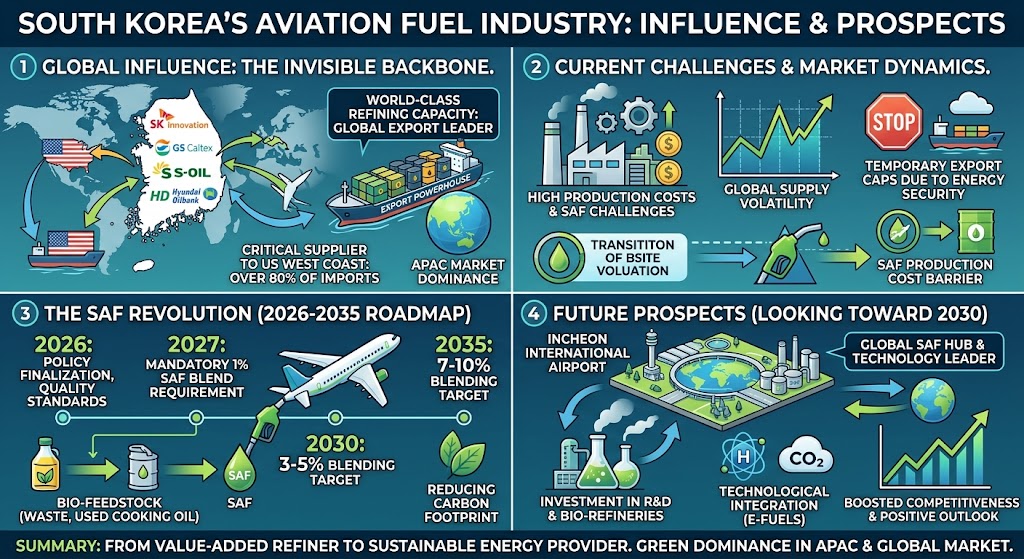
The influence of South Korean refiners—specifically SK Innovation, GS Caltex, S-Oil, and HD Hyundai Oilbank—extends far beyond the peninsula. Korea consistently ranks among the top global exporters of refined petroleum products.
- North American Dependency: South Korea remains the single most important supplier of jet fuel to the U.S. West Coast, accounting for over 80% of imports at major hubs like LAX and SFO.
- Price Leadership: The "Singapore Crack Spread" for jet fuel is heavily influenced by the supply volume originating from Korean refineries, making Korea a price-setter in the Asia-Pacific region.
- Advanced Refining Capacity: With one of the world's highest "complexity ratios," Korean refineries can produce ultra-pure, high-spec jet fuel (Jet A-1) more efficiently than most regional competitors.
2. The Strategic Shift: The SAF Revolution
The industry is currently undergoing its most significant transformation since the 1970s: the pivot to Sustainable Aviation Fuel (SAF). In response to global CORSIA (Carbon Offsetting and Reduction Scheme for International Aviation) mandates, Korea is positioning itself as a leader in green energy.
South Korean SAF Roadmap (2026-2035)
| Phase | Target Year | Objective |
|---|---|---|
| Policy Foundation | 2026 | Finalizing domestic quality standards and tax incentive structures. |
| Mandatory Blending | 2027 | Implementation of a 1% SAF blend requirement for all international flights. |
| Industrial Scaling | 2030 | Expansion to 3-5% blending; completion of major dedicated SAF bio-refineries. |
| Net Zero Target | 2050 | Full decarbonization of the domestic aviation fuel supply chain. |
3. Current Challenges and Market Dynamics
While the outlook is promising, 2026 brings specific headwinds that the industry must navigate:
"The intersection of geopolitical instability in the Middle East and the high cost of bio-feedstock has created a 'double-squeeze' on refining margins this year."
- Geopolitical Risk: Fluctuations in crude oil prices due to Middle Eastern tensions have led the Korean government to implement temporary export caps to prioritize domestic energy security.
- Feedstock Procurement: As demand for SAF skyrockets, securing sustainable bio-feedstocks (like Used Cooking Oil or tallow) has become a competitive global race.
4. Future Prospects: High-Flying Ambitions
Looking toward the end of the decade, the South Korean aviation fuel industry is expected to evolve from a traditional "fossil fuel refiner" into a "Total Energy Provider."
Key Growth Drivers:
- Public-Private Partnerships: The government’s "Green New Deal" provides massive R&D subsidies for co-processing technology (using bio-oils in existing refinery units).
- Global Hub Status: Incheon International Airport is aggressively expanding its SAF refueling infrastructure to maintain its status as the premier cargo and passenger hub of Northeast Asia.
- Hydrogen Integration: Leading refiners are exploring e-fuels (synthetic fuels produced from captured CO2 and green hydrogen), representing the next generation of aviation energy beyond 2030.