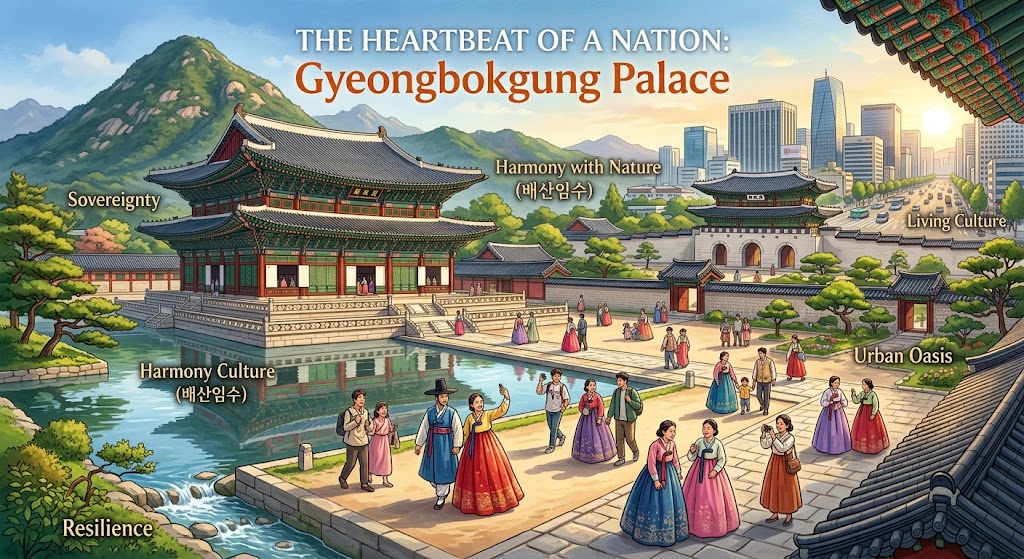
The Heartbeat of a Nation
Understanding why Gyeongbokgung Palace is the most cherished landmark in Korea.
To a casual observer, Gyeongbokgung Palace is a stunning collection of traditional wooden architecture. But to the Korean people, it is much more—it is a physical manifestation of their history, a symbol of their resilience, and the spiritual "Soul of Seoul." Here is why this palace holds such a special place in the hearts of Koreans.
1. The Ultimate Symbol of Sovereignty
Built in 1395, Gyeongbokgung was the main royal palace of the Joseon Dynasty. It wasn't just where the King lived; it was the center of the universe for Korean politics, culture, and science for centuries. For many Koreans, the palace represents the very foundation of their national identity. Loving Gyeongbokgung is an act of honoring the ancestors who built the nation.
2. Architectural Harmony with Nature
Koreans have a unique aesthetic philosophy called "Baesanimsu" (배산임수), which dictates that buildings should be positioned with mountains at the back and water in front. Gyeongbokgung is the gold standard of this harmony. Framed by the majestic Bugaksan Mountain, the palace feels as though it grew out of the earth rather than being built upon it. Key features include:
- Dancheong: The vibrant, multicolored patterns on the eaves that symbolize protection and cosmic balance.
- Geunjeongjeon: The throne hall where the "Great Blessing" (the meaning of Gyeongbok) was meant to emanate to the entire country.
3. A Living Cultural Playground
One of the most beautiful sights in modern Seoul is seeing thousands of young people and tourists dressed in Hanbok (traditional clothing) walking through the palace gates. Gyeongbokgung has successfully transitioned from a static museum to a living cultural space. By offering free admission to those in traditional dress, the palace has sparked a cultural revival, making history feel trendy and accessible to the younger generation.
4. An Oasis Amidst the Concrete
Seoul is one of the fastest, most high-tech cities on the planet. In the middle of this forest of glass and steel, Gyeongbokgung offers a moment of profound silence. Stepping through the Gwanghwamun Gate feels like a time-traveling escape. For busy Seoulites, the palace grounds serve as a vital "urban lung" where they can reconnect with a slower, more contemplative pace of life.
5. A Testament to Resilience
Gyeongbokgung has a tragic history—it was destroyed during invasions and partially dismantled during the colonial era. However, the Korean government and people have spent decades meticulously restoring it to its former glory. This refusal to let history be erased makes the palace a symbol of the "indomitable spirit" of the Korean people. It is a reminder that no matter the hardship, beauty and tradition can always be reclaimed.
"Gyeongbokgung is not just a relic of the past; it is the mirror in which Koreans see their past, present, and future reflected all at once."