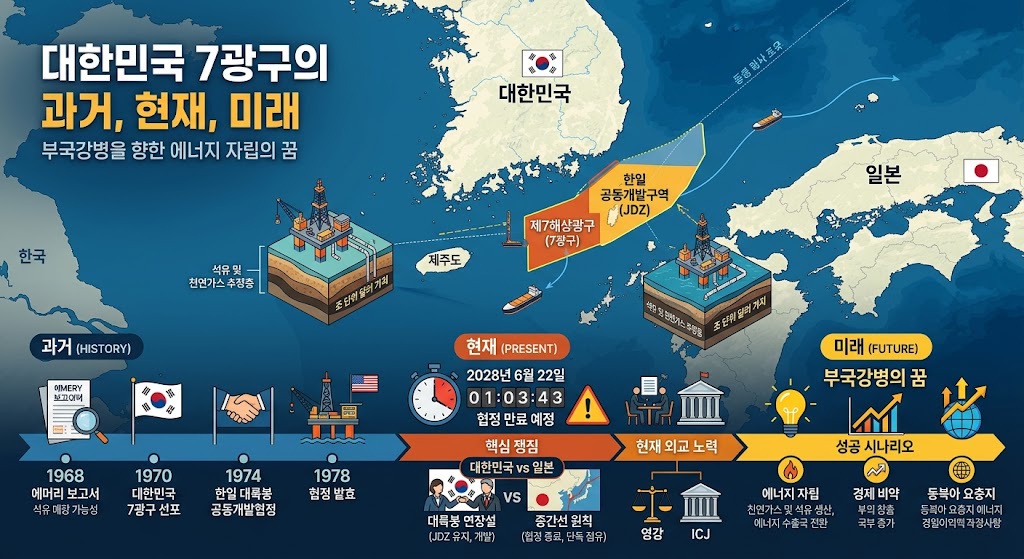
Block 7: The "Asian Persian Gulf"
A Strategic Blueprint for South Korea's Energy Sovereignty and Economic Leap
Located south of Jeju Island and stretching toward the Okinawa Trough, Block 7 (The 7th Mining Block) represents one of the most significant geopolitical and economic interests in South Korean history. As of 2026, the nation stands at a critical crossroads that will determine whether this vast sub-marine treasure becomes a pillar of national wealth or a lost opportunity.
1. The Past: The Dream of an Oil-Producing Nation
The saga of Block 7 began in 1968 with the 'Emery Report' published by the UN Economic Commission for Asia and the Far East (ECAFE). The report suggested that the continental shelf between Taiwan and Japan might contain one of the world's most prolific oil and gas reserves.
- 1970 Territorial Declaration: Based on the 'Natural Prolongation' principle of international law at the time, the Park Chung-hee administration declared sovereignty over Block 7.
- 1974/1978 JDZ Agreement: Following strong protests from Japan, the two nations signed the Joint Development Zone (JDZ) agreement, a 50-year pact to explore and develop the area together.
- Stagnation: While initial surveys in the 1980s showed promising signs of hydrocarbons, Japan unilaterally halted exploration in 1986, citing a lack of economic viability—a move widely seen as a strategic delay.
2. The Present (2026): A Diplomatic Race Against Time
The 50-year JDZ agreement is set to expire on June 22, 2028. We are currently in a period of high diplomatic tension and legal preparation.
"Since June 22, 2025, either nation has been legally permitted to notify the other of the intent to terminate the agreement. This marks the beginning of a high-stakes legal battle over maritime boundaries."
Japan’s current strategy leans toward waiting for the agreement to lapse. Since modern international law now favors the 'Median Line Principle' over 'Natural Prolongation,' Japan calculates that it could claim more than 90% of the area if the agreement ends. South Korea, meanwhile, is intensifying efforts to restart joint exploration and building a robust case for international arbitration.
3. The Future: A Vision for a Wealthy Nation
Successfully securing and developing Block 7 would fundamentally transform South Korea from an energy importer into a strategic energy power.
| Category | Expected Impact | National Significance |
|---|---|---|
| Energy Security | Substitution of oil/gas imports | Energy independence and trade balance improvement |
| Economic Value | Billions in untapped resources | Funding for national welfare and next-gen R&D |
| Geopolitical Leverage | Maritime dominance in the East China Sea | Strengthened position in Northeast Asian diplomacy |
| Industrial Growth | Revitalization of offshore plants | Global leadership in energy extraction technology |
Building a "Strong and Wealthy" Republic
Securing Block 7 is more than just a resource grab; it is about establishing a 'Strategic Stronghold' for survival in a resource-scarce world. If realized, the "Black Gold" beneath these waters will serve as the primary catalyst for South Korea to join the ranks of the world's leading economic superpowers.
4. Conclusion: A Mission for the Next Generation
Block 7 is a legacy of hope from our predecessors and a vital asset we must protect for future generations. The time remaining until 2028 requires a sophisticated combination of international legal expertise, unwavering diplomatic pressure, and unified public support. The successful exploration of Block 7 will be the moment South Korea truly claims its place as a maritime and energy sovereign nation.