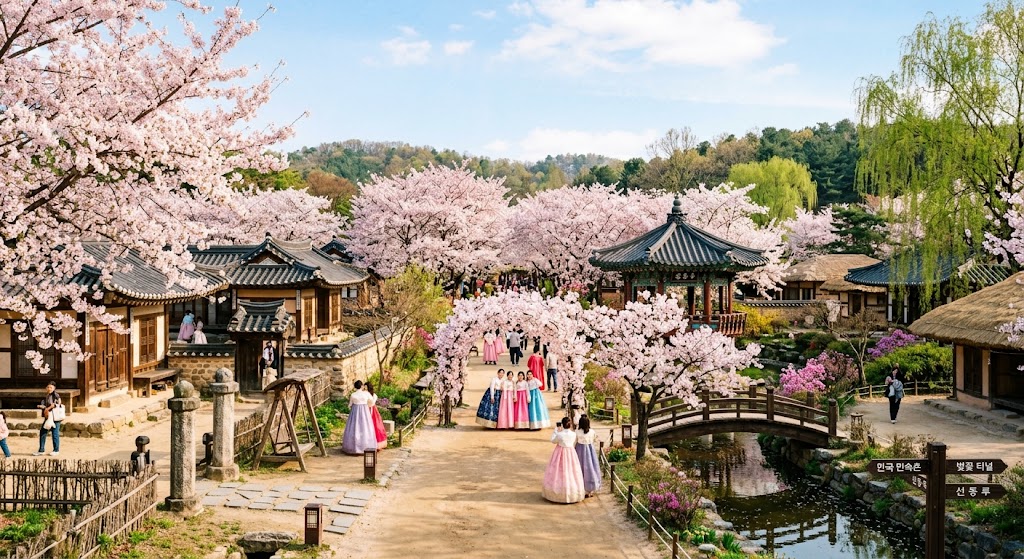
The Epic of Korean Cherry Blossoms: Historical Turbulence and Cultural Blooming
1. Deep Roots and Identity: The Origin of the King Cherry
The perception of cherry blossoms in Korea has long been a complex intersection of love and historical resentment. In the distant past, cherry trees were not merely ornamental. Records from the Goryeo and Joseon dynasties reveal that cherry wood (specifically from wild mountain varieties) was highly valued for its durability and elasticity. It was a critical military resource used for crafting traditional Korean bows and was also utilized in creating woodblocks for printing, such as the Tripitaka Koreana.
In modern times, the most significant turning point was the scientific discovery regarding the King Cherry Tree (Prunus yedoensis). In 1908, a French missionary named Father Taquet discovered a natural habitat of King Cherry trees on the northern slopes of Mt. Halla on Jeju Island. This provided scientific evidence that the origin of this specific variety, often associated solely with Japan, could be traced back to the Korean Peninsula. This discovery allowed Koreans to re-embrace the flower not as a symbol of occupation, but as a part of their own natural heritage.
2. Scars of the Past: The Changgyeongwon Era
The popularization of "flower viewing" in Korea is ironically linked to a painful chapter of the Japanese colonial period. To degrade the authority of the Joseon Dynasty, the colonial government converted Changgyeonggung Palace into a zoo and botanical garden, planting thousands of cherry trees and renaming it 'Changgyeongwon.'
While Changgyeongwon became a major destination for city dwellers, the cherry trees were viewed with hostility following liberation in 1945. Many were cut down as "remnants of imperialism." It wasn't until the 1980s, through the "Changgyeonggung Restoration Project," that the palace was returned to its original royal state. The cherry trees were relocated, and the blossom finally evolved from a tool of cultural suppression into an object of pure aesthetic appreciation.
3. The Rise of Korean Localism: Jinhae to Yeouido
The widespread presence of cherry blossoms across the nation today is largely due to the reforestation projects of the 1960s and 70s. Certain locations have since become legendary:
- Jinhae Gunhangje: Originally a memorial service for Admiral Yi Sun-sin, this festival in the naval port of Jinhae has grown into a world-class event where 360,000 King Cherry trees bloom simultaneously.
- Yeouido Yeouiseo-ro: Located behind the National Assembly in Seoul, this cherry blossom tunnel offers an urban escape and a symbol of spring for city workers.
- Gyeongju Bomun Complex: The blossoms here blend with the ancient architecture of the Silla Kingdom, creating a unique atmosphere that bridges history and nature.
4. The Modern 'Cherry Blossom Fever': A Cultural Phenomenon
For modern Koreans, the blooming of cherry blossoms is a collective annual ritual. The proliferation of smartphones and social media has fueled a craze for capturing the perfect "life-shot," turning a simple walk into a shared cultural experience.
A Season Defined by Music: 'Cherry Blossom Ending'
The 2012 hit song "Cherry Blossom Ending" by Busker Busker changed how Koreans experience spring. The song re-enters the music charts every single year when the first buds appear, earning the nicknames "Cherry Blossom Zombie" (because it keeps coming back to life) and "Cherry Blossom Pension" (providing steady royalties to the artist). It has become a cultural trigger; when the melody is heard on the streets, people know that spring has truly arrived.
The Aesthetics of the Ephemeral
The intense passion Koreans have for cherry blossoms stems from their fleeting nature. The flowers reach full bloom and vanish within a week, often ending in a "flower rain" (Kkot-bi) where petals fall like snow. This resonates with the traditional East Asian sentiment that beauty is most precious when it is temporary. It drives a dynamic culture of real-time bloom tracking and nighttime viewings to catch the peak moment.
5. Conclusion: A Flower of Resilience and Coexistence
Korean cherry blossoms have endured 100 years of turbulent history. Moving past a painful past where they were forced upon the landscape, they have reclaimed their identity through scientific discovery and public affection.
Today, the laughter of people gathered under the pink canopy reflects the resilience of the Korean spirit—healing past wounds and celebrating the present. The fluttering petals are no longer a foreign sight, but the most authentic face of spring in Korea.
```