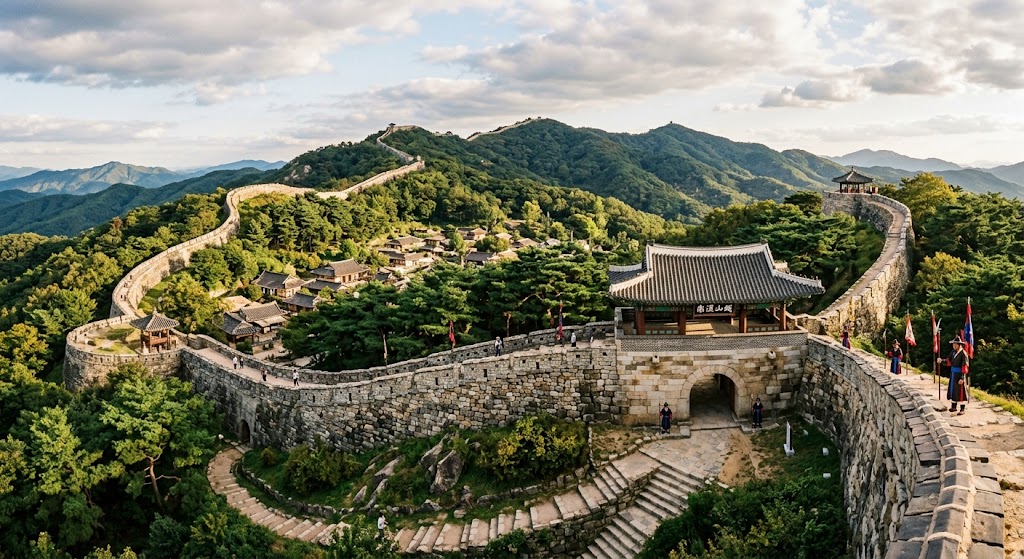
Guardians of the Ridge:
The Legacy and Future of Korean Mountain Fortresses
Korea is a land where mountains comprise over 70% of the territory. For millennia, these granite peaks were not just scenic backdrops but the very backbone of national survival. The Sanseong (Mountain Fortress) represents a unique defensive philosophy known as "Ipsan Suseong" (Entering the mountains to defend the castle). Unlike the massive walled cities of the plains found in China or Europe, Korean fortresses were built atop rugged ridges to leverage natural terrain as an impenetrable shield.
1. The Scientific Architecture of Sanseong
Korean mountain fortresses were masterpieces of engineering, designed to maximize defensive efficiency with minimal manpower. Their structures were evolved to counter specific siege tactics while preserving the lives of both soldiers and civilians.
Key Structural Elements
- Chi (Bastion): Rectangular projections from the main wall. These allowed defenders to strike the flanks of enemies attempting to scale the walls, eliminating "blind spots."
- Ongseong (Barbican): A secondary curved wall protecting the main gate. It forced attackers into a narrow "killing zone" where they could be showered with projectiles from three sides.
- Yeojang (Parapet): Low battlements atop the wall with embrasures (holes) specifically angled for archers or musketeers to fire while remaining undercover.
- Guraengi Construction: A sophisticated technique where natural stones were meticulously carved to fit the irregular surfaces of foundation rocks, creating a "Lego-like" interlocking bond that resisted earthquakes and heavy rain.
2. A Chronicle of Resilience: Historical Evolution
The history of Korean fortresses is a timeline of innovation born from necessity. From the iron-willed expansion of the Three Kingdoms to the scientific advancements of the late Joseon Dynasty, each era left its mark on the stone walls.
| Historical Era | Core Philosophy & Strategy | Notable Examples |
|---|---|---|
| Three Kingdoms (Goguryeo, Baekje, Silla) | Foundational stone-stacking techniques; fortresses acted as offensive bases for territorial expansion. | Achasanseong, Gongsanseong, Samnyeonsanseong |
| Goryeo Dynasty | Resistance against nomadic invasions (Khitan, Mongol). Fortresses became temporary capitals for the royal court. | Ganghwa Jungseong, Jukjusanseong |
| Joseon Dynasty | Systemization of defense after the Imjin War. Introduction of brickwork and firearms-oriented design. | Namhansanseong, Bukhansanseong, Hwaseong (Suwon) |
The Pinnacle: Suwon Hwaseong
In the late 18th century, King Jeongjo oversaw the construction of Suwon Hwaseong. This fortress was a synthesis of traditional Korean mountain defense and Western military science. Utilizing cranes (Geojunggi) and reinforced bricks, Hwaseong featured an unprecedented level of defensive depth, earning its place as a UNESCO World Heritage site and the crown jewel of Oriental fortress architecture.
3. The Future: From Barriers to Bridges
As the drums of war faded, the Sanseong transitioned into a cultural and spiritual asset. The future of these fortresses lies in their transformation into Smart Heritage and global cultural landmarks.
Digital Reconstruction & Metaverse
Many ancient fortresses, particularly those of the Goguryeo era, currently lie in ruins or are inaccessible. The future utilizes Digital Twin technology to reconstruct these sites in virtual spaces. AR (Augmented Reality) allows modern hikers to look through their smartphones and see the 5th-century battlements rise from the overgrown ridges, bridging the gap between history and the 21st century.
Ecological and Healing Spaces
Korean mountain fortresses are increasingly recognized for their "Bio-Heritage" value. Since they were built along natural ridges, they preserve old-growth forests and biodiversity. The future "Sanseong Trails" are being developed as paths for mental healing, where citizens can walk the same paths as their ancestors, finding peace in the very places that once stood at the center of survival.
K-Heritage on the Global Stage
Following the global success of Korean content, the "Sanseong" is becoming a destination for global travelers seeking authenticity. Future management focuses on storytelling—narrating the tales of the commoners who carried the stones—ensuring that these stone walls are seen not just as military relics, but as monuments to human endurance and community spirit.