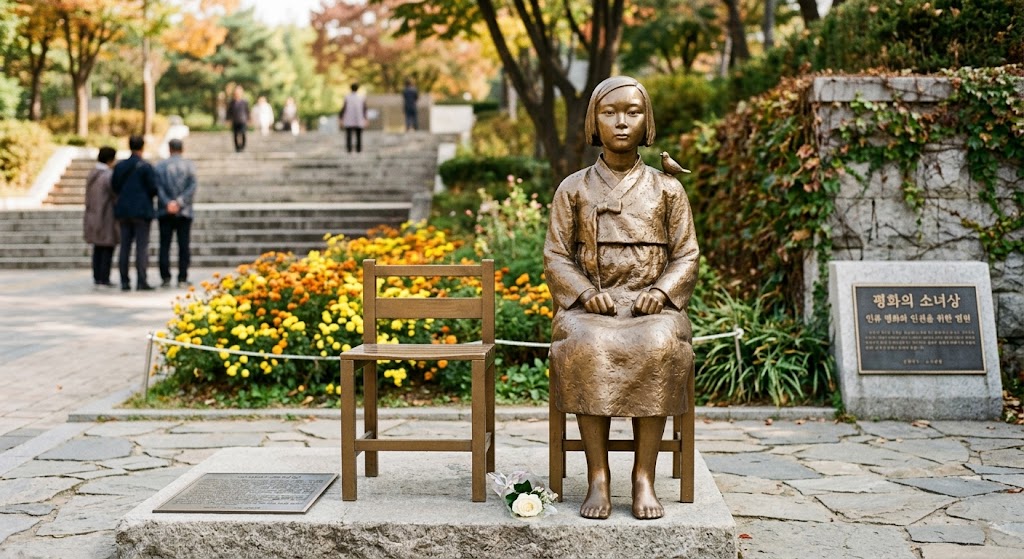
The Statue of Peace
A Monument of Remembrance, Justice, and Our Shared Future
1. Introduction: More Than Just Bronze
In front of the former Japanese Embassy in Seoul stands a bronze statue of a young girl. Known officially as the "Statue of Peace" (Pyeonghwa-ui Sonyeosang), she sits quietly, yet her presence speaks volumes. First erected on December 14, 2011, to mark the 1,000th Wednesday Demonstration for the "Comfort Women" victims of the Japanese military, this statue has evolved from a local memorial into a global icon for human rights.
As we navigate the complexities of the 21st century, the Statue of Peace serves as a bridge between a painful past and an aspirational future. To understand its role in a future society, one must first decipher the silent language of its design and the universal values it champions.
2. Decoding the Symbolism: A Silent Testimony
Every detail of the statue, crafted by artists Kim Seo-kyung and Kim Eun-sung, is meticulously designed to represent the historical reality and the unyielding spirit of the victims.
| Symbolic Element | Visual Representation | Philosophical Meaning |
|---|---|---|
| Roughly Cut Hair | Jagged, uneven bob cut | Represents the forced severance from family and hometown; the loss of one's youth and identity. |
| The Small Bird | Perched on the shoulder | A messenger of peace and a bridge between the deceased victims and the current generation. |
| Raised Heels | Bare feet not touching the ground | Symbolizes the lack of a "place to belong" even after returning home, due to social stigma and government neglect. |
| Clenched Fists | Hands resting on the lap | A manifestation of the firm resolve to receive a sincere apology and achieve historical justice. |
| The Empty Chair | A vacant seat next to the girl | Represents the victims who have passed away and an invitation for the public to sit and engage in empathy. |
Furthermore, the Shadow of an Old Woman engraved on the pedestal reminds us that while the crime was committed against young girls, the pain lasted a lifetime. The white butterfly within that shadow symbolizes "Rebirth"—the hope that the souls of the victims may find the freedom in the afterlife that they were denied in youth.
3. The Statue’s Vision for a Future Society
The significance of the Statue of Peace is not confined to the history of the 20th century. It offers a blueprint for the ethical foundations of the society we are building today.
A Global Standard for Women's Human Rights
In a future society where global integration continues, the statue serves as a universal warning against wartime sexual violence. It transcends nationalism and ethnic boundaries, standing as a guardian for the dignity of women in all conflict zones—from the past in East Asia to current crises across the globe. It demands that the "future" must be a space where the physical and psychological integrity of every individual is protected by international law and collective conscience.
The Power of Collective Memory in a Digital Age
As we move toward a highly digitized future, the risk of "historical amnesia" grows. The Statue of Peace acts as a physical anchor in a virtual world. It teaches future generations that remembrance is an active form of justice. By remembering the victims, society ensures that the structural violence of the past cannot be easily replicated under new guises.
Fostering "Active Peace" Over "Passive Silence"
The statue does not look down in shame; she looks forward with a clear, steady gaze. This represents a shift from "passive peace" (the mere absence of war) to "active peace" (the presence of justice and truth). A future society inspired by this image is one where citizens are encouraged to speak out against injustice, even when it is uncomfortable or politically sensitive.
4. Ethical Responsibility in a Technological Era
As Artificial Intelligence and robotics redefine what it means to be human, the Statue of Peace refocuses our attention on the irreplaceable value of human suffering and empathy. While machines can process data, only humans can bear witness.
"Those who cannot remember the past are condemned to repeat it." – George Santayana
The "Empty Chair" next to the statue is perhaps the most significant element for the future. It is a space for dialogue. In the future, this chair will be filled by students, activists, and world leaders who must sit beside the history of the "Comfort Women" to find the wisdom necessary to prevent future atrocities.
5. Conclusion: Carrying the Torch of Truth
The Statue of Peace is far more than a monument to the victims of the Japanese military's sexual slavery. It is a living testament to the resilience of the human spirit and a constant reminder that true peace is built on the foundation of truth, not the convenience of silence.
In the future society, the statue will continue to serve as a compass. It tells us that progress is not measured solely by technological advancement or economic growth, but by how well we protect the most vulnerable and how honestly we confront our own histories. By sitting in the empty chair, we promise to be the voice for those who were silenced, ensuring that the light of human rights never fades in the coming centuries.