Strategic Analysis Report
1. Analysis of Excessive Labor Demands
The National Samsung Electronics Union (NSEU) has initiated a historical shift in labor-management relations by demanding significant wage hikes and a total restructuring of the Overall Performance Incentive (OPI) system[cite: 2, 3]. While employee welfare is critical, the current demands present specific structural risks to the company's long-term health:
- Cyclical Misalignment: The semiconductor industry is famously volatile. Rigid labor cost increases during downturns—such as the massive 2023 deficits—threaten the cash reserves required for essential R&D and survival[cite: 1, 2].
- Erosion of Meritocracy: Samsung’s global success is rooted in the principle of "Reward for Performance." Standardizing compensation across divisions regardless of output risks losing elite engineers to competitors like SK Hynix, TSMC, or NVIDIA[cite: 1, 3].
2. Semiconductor Manufacturing Excellence
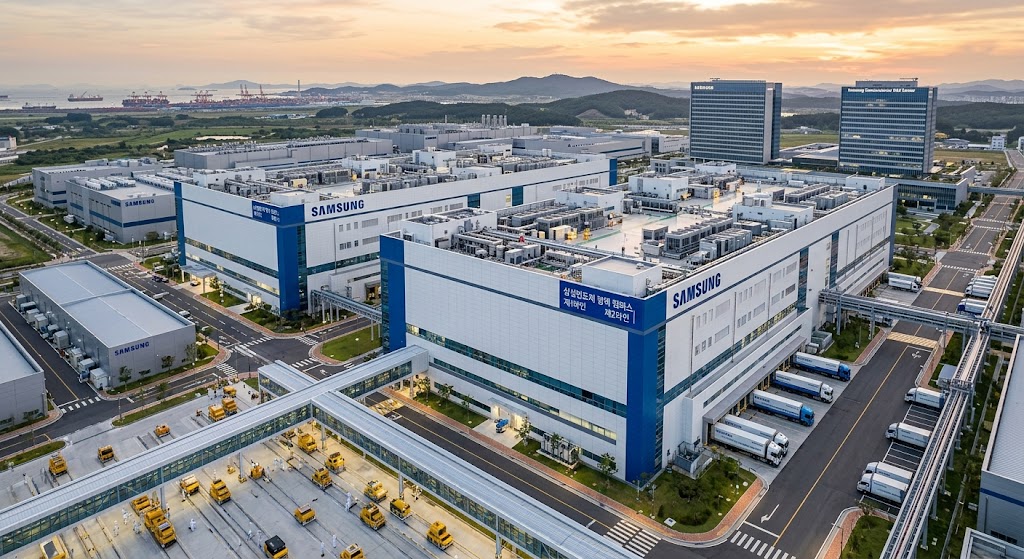
To understand the high stakes of operational stability, one must consider the complexity of the 8 Essential Processes that transform raw silicon into advanced logic and memory chips[cite: 3].
A single disruption in the "Front-end" or "Back-end" lines can lead to catastrophic losses. For instance, an hour of downtime in a world-class Fab can incur costs reaching hundreds of billions of KRW[cite: 1, 3].
The 8-Stage Lifecycle:
1. Wafer Prep → 2. Oxidation → 3. Photolithography → 4. Etching → 5. Deposition → 6. Metal Interconnect → 7. EDS → 8. Packaging[cite: 3].
3. Future Outlook: The AI & Foundry Roadmap
Despite current friction, Samsung is doubling down on "First Mover" technologies to reclaim dominance in the AI era[cite: 1, 3].
| Focus Area | Core Technology | Impact Projection (2025-2027) |
|---|---|---|
| Memory | HBM4 (6th Gen) | Integration of logic and memory to dominate AI server supply[cite: 2, 3]. |
| Foundry | 2nm GAA Node | Superior power efficiency over competitor FinFET structures[cite: 1, 3]. |
| System LSI | AI-enhanced Exynos | Market lead in "On-Device AI" for mobile ecosystems[cite: 3]. |
4. Conclusion
Samsung Electronics stands at a pivotal junction where internal cohesion is as vital as technological innovation[cite: 2]. The resolution of labor disputes must shift from "distribution conflict" to "cooperative growth" to ensure the company does not miss the "Golden Time" for HBM4 and next-generation Foundry verification[cite: 3]. If Samsung stabilizes its organization and successfully ramps up its 2nm GAA process, it will solidify its status as the foundational provider for the AI revolution[cite: 1, 3].