The US-China Hegemonic Rivalry and the Future of South Korea
A Geopolitical and Geoeconomic Strategic Assessment
1. Introduction: The New Cold War and the Peninsular Dilemma
The contemporary international order is increasingly defined by an all-encompassing systemic rivalry between the United States and the People's Republic of China. This friction is not a mere diplomatic disagreement or a transient trade dispute; rather, it is a structural power transition challenge that reflects historical Thucydidean dynamics. While Washington seeks to preserve the post-WWII rules-based, liberal international order anchored by multilateral alliances and maritime freedom, Beijing aims to reassert its historical preeminence in East Asia and reshape regional economic and security architectures.
For the Republic of Korea (ROK), this structural friction hits with unique immediacy. Geographically positioned on a peninsula where the interests of major continental powers (China and Russia) collide with maritime powers (the United States and Japan), South Korea faces an acute existential challenge. Historically, this reality manifested as the strategic dilemma known as An-Mi-Gyeong-Jung (안미경중)—relying on the United States for national security while depending on China for economic growth. However, as the hegemonic conflict intensifies across technology, security, and supply chains, the space for strategic ambiguity has collapsed, forcing Seoul to forge a more resilient and proactive grand strategy.
2. The Shift from Geopolitics to Geoeconomics: Technology as Leverage
Historically, geopolitical survival on the Korean Peninsula depended almost entirely on military deterrence and troop deployments. In the 21st century, however, the concept of security has expanded into Geoeconomics—the use of economic instruments and technological superiority to project state power. The primary battleground between Washington and Beijing is no longer just physical terrain, but control over the foundational building blocks of the future economy: artificial intelligence (AI), quantum computing, biotechnology, next-generation EV batteries, and advanced logic semiconductors.
This shift has radically altered South Korea's strategic value:
- The "Super-Gap" Lever: South Korea is no longer a passive buffer state caught between empires. It is an industrial heavyweight, commanding a dominant share of global memory semiconductor production (DRAM and NAND Flash) through global leaders like Samsung Electronics and SK Hynix.
- Superpower Pressure: Because advanced weapon systems, space infrastructure, and commercial networks rely entirely on these high-tech components, both superpowers view South Korea as indispensable. The U.S. seeks to bind Seoul within Western-led tech coalitions (such as the Chip 4 Alliance and "friend-shoring" initiatives) to cut off Beijing's access to high-end node manufacturing. Conversely, China utilizes its vast consumer market and its monopoly over critical raw materials (like rare earth elements) to prevent Seoul from fully decoupling from the Chinese economy.
3. The Maritime Security Constraint: China’s Island Chains Strategy
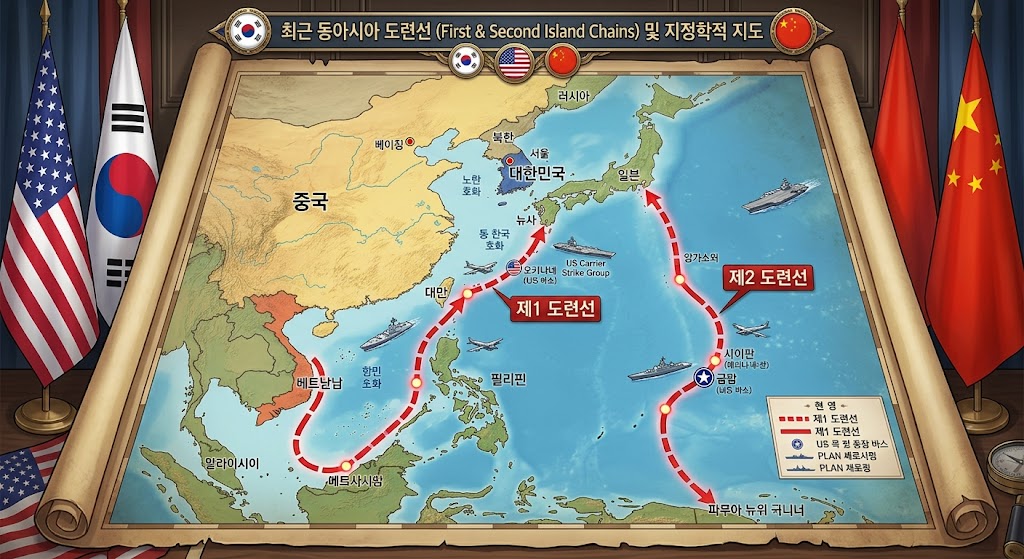
To assess South Korea's future, one must evaluate Beijing's maritime defense and expansion framework, structurally outlined by the Island Chains (도련선) doctrine.
- The First Island Chain (제1도련선): Running from the Kuril Islands through Japan, the Ryukyu Islands, Taiwan, and the northwestern Philippines down to Borneo, this line represents China’s immediate security perimeter. Beijing’s Anti-Access/Area Denial (A2/AD) assets are deployed specifically to deny U.S. military intervention within this boundary.
- The Second Island Chain (제2도련선): Extending further into the Pacific from the Ogasawara island arc through the Mariana Islands—encompassing the critical U.S. military forward hub of Guam—this line marks China’s long-term goal of pushing Western naval projection back to Hawaii.
Because South Korea's vital maritime trade lanes and energy supply lines transit directly through the East and South China Seas, any localized flashpoint along the First Island Chain—most notably a cross-strait conflict over Taiwan—would instantly trigger an energy and security crisis for Seoul.
4. Strategic Challenges and Super-Gap Opportunities
| Domain | United States' Alignment Objectives | China's Mitigation & Pressure Strategy | South Korea's Future Action Plan |
|---|---|---|---|
| Politics & Security | Stronger U.S.-Japan-ROK trilateral alignment; expansion of Indo-Pacific security networks. | Preventing trilateral containment; keeping North Korea as an active buffer zone. | Value-Based Diplomacy: Solidifying the U.S. alliance for core defense while keeping high-level crisis prevention channels open with Beijing. |
| Technology & Supply Chain | Decoupling/De-risking from Chinese ecosystems; reshoring tech manufacturing to the U.S. | Accelerating domestic self-reliance; leveraging market access and rare mineral supplies. | Super-Gap Monopoly: Maintaining an absolute technological edge over all competitors so that both sides remain dependent on Korean tech. |
5. Conclusion: South Korea's Future Path
The future of South Korea in the face of the US-China hegemonic rivalry rests on its ability to transform traditional geographic vulnerability into modern geoeconomic indispensability. To secure its national sovereignty and strategic autonomy, Seoul must focus on three core trajectories:
- Securing Technological Sovereignty: By maintaining an absolute "super-gap" (초격차) in advanced technologies (HBM, logic foundries, and next-gen batteries), South Korea can guarantee that neither Washington nor Beijing can afford to economically isolate or coerce it.
- Coalitions with Middle Powers: Seoul must diversify its economic dependencies by expanding deep supply-chain and trade networks with the European Union, India, Australia, and ASEAN nations, reducing its vulnerability to unilateral economic sanctions.
- Proactive Multilateral Engagement: While the ironclad U.S.-ROK Mutual Defense Treaty remains the irreplaceable anchor for deterring the North Korean nuclear threat, South Korea must leverage its rising cultural software (K-Culture) and hardware capabilities (K-Defense/K-Bangsan) to act as a resilient "Rule-Maker" and stabilizing middle power in the Indo-Pacific region.
Strategic Summary: South Korea's future lies not in choosing sides blindly, but in creating a structural position where its tech ecosystem and military-industrial capacity remain entirely irreplaceable to both competing blocks.