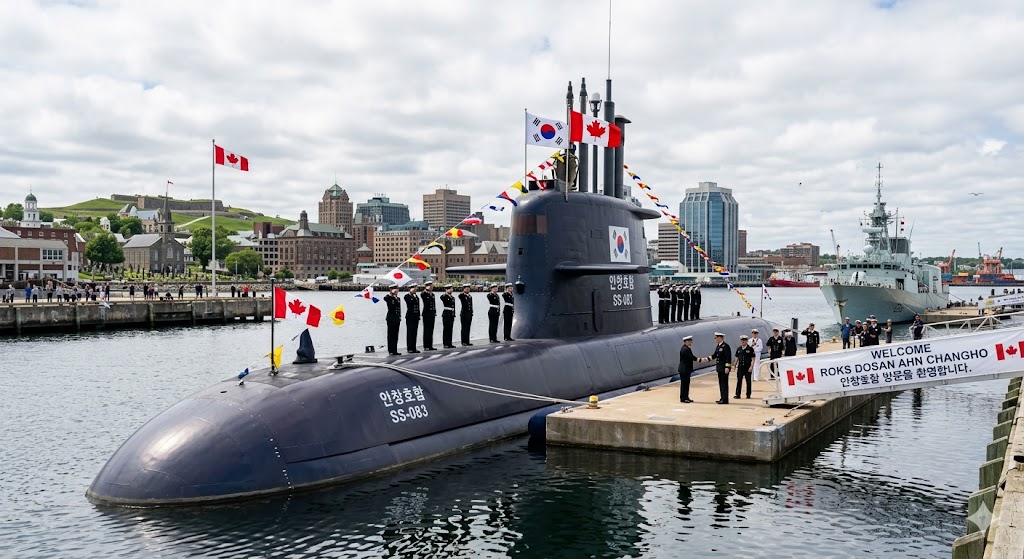
South Korea's Victory in Canada's Submarine Project & Future Outlook
The Canadian Patrol Submarine Project (CPSP), which aims to introduce 12 next-generation submarines for the Royal Canadian Navy, stands as the largest defense procurement in global naval history, with a total budget estimated at approximately $44 billion USD (KRW 60 trillion)—consisting of $15 billion for acquisition and $29 billion for a 30-year Maintenance, Repair, and Overhaul (MRO) lifecycle. South Korea (led by Team Korea, uniting Hanwha Ocean and HD Hyundai Heavy Industries) and Germany (TKMS) have emerged as the definitive frontrunners. This report analyzes South Korea's strategic advantages and the transformative future outlook upon winning this monumental contract.
1. South Korea's Core Competitive Advantages
South Korea’s KSS-III Batch-II (Dosan Ahn Changho-class) submarine offers distinct operational capability and industrial synergy advantages over its European competitors, aligning directly with Canada's strategic imperatives.
- Unrivaled Delivery Performance (Accelerated Deployment): The Royal Canadian Navy's aging Victoria-class submarines face critical readiness challenges, making rapid delivery a paramount priority. Leveraging its highly efficient domestic shipyard infrastructure, South Korea has proposed an aggressive but highly reliable timeline to deliver the first batch of operational submarines by 2035, significantly outpacing European timelines.
- Superior Platform Size and Endurance: Displacing over 3,600 tons, the KSS-III Batch-II is significantly larger than Germany's Type 212CD (2,500 tons). This extra displacement is critical for Canada's maritime geography, allowing for longer transits, extended arctic operations, higher payload capacity, and world-class underwater endurance powered by advanced lithium-ion battery technology.
- Unmatched Industrial Benefits (Offsets): Canada enforces strict Industrial and Technological Benefits (ITB) policies. South Korea holds a powerful leverage card through major existing investments in Canada by conglomerates like Hyundai Motor Group and LG Energy Solution. By linking the naval contract to comprehensive long-term economic partnerships in automotive and green energy sectors, South Korea offers unmatched economic value.
※ The Final Hurdle: Navigating the NATO/Five Eyes Alliance Dynamics
Germany relies heavily on geopolitical arguments, urging Canada to join a standardized 24-ship 'NATO Conventional Submarine Network' to ensure European-Atlantic interoperability. To counter this, the South Korean government, Navy, and Defense Acquisition Program Administration (DAPA) are executing high-level security diplomacy to prove KSS-III’s seamless interoperability with US and allied systems.
2. Strategic Future Outlook Following a South Korean Victory
Securing the CPSP contract will serve as a massive structural turning point for South Korea's defense industry and national economy.
① Penetrating the NATO and Five Eyes Defense Markets
Exporting submarines to Canada represents South Korea's first breakthrough into the North American defense market and a premium 'Five Eyes' intelligence alliance nation. Successfully passing Canada's stringent requirements will serve as an ultimate validation, positioning South Korea to sweep upcoming submarine replacement programs in Poland, the Philippines, and Australia.
② Securing a 30-Year High-Value MRO Ecosystem
Submarines generate nearly double their initial acquisition cost through long-term maintenance, repairs, and modernization. Securing the $29 billion MRO portion of the project will provide domestic shipbuilders and hundreds of precision component manufacturing suppliers with an unshakeable, long-term growth engine and stable high-tech employment for decades.
③ Catalyst for Cross-Domain K-Defense Package Exports
South Korean defense firms have bundled the submarine bid with holistic proposals, including the local assembly of Redback Infantry Fighting Vehicles (IFVs) and potential supplementary acquisitions of K9 Self-Propelled Howitzers and Chunmoo MRLS systems. A victory at sea will act as a force multiplier, unlocking large-scale ground and aerospace systems contracts across North America.
3. Conclusion
South Korea’s submarine technology initially began by absorbing German expertise a few decades ago. Today, it has achieved the historic feat of independently developing the world’s first high-end conventional submarine integrating both lithium-ion batteries and Vertical Launch Systems (VLS). Winning the Canadian procurement will transcend a mere defense sale; it will firmly establish South Korea as an indispensable tier-one security provider and core supply chain partner within the global democratic alliance.