Love That Bloomed in the Lowest Places:
Missionary Elisabeth Johanna Shepping
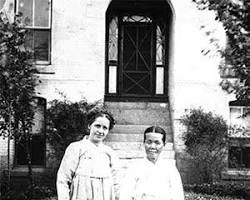
Among the many blue-eyed missionaries who set foot on Korean soil during its darkest years, there was one who became a true mother to the most marginalized and forsaken. Her name was Elisabeth Johanna Shepping (1880–1934), affectionately known by her Korean name, Seo Seo-pyeong.
Her life of profound love and sacrifice transcended traditional religious missionary work. During the Japanese colonial period, she fundamentally transformed the lives of impoverished women, Hansen's disease (leprosy) patients, and orphaned children who were utterly abandoned by society.
1. "Not Success, But Service"
Born in Germany and trained in nursing in the United States, Shepping arrived in Korea in 1912 at the age of 32 as a nursing missionary for the American Southern Presbyterian Mission. Centering her activities in Gwangju, she hung a handwritten motto on her bedroom wall that she lived by until her final breath:
"Not Success, But Service."
True to this pledge, she rejected worldly standards of "success" and dedicated herself entirely to serving those in agony. She never spent the missionary stipends sent from the United States on herself; instead, every penny was used to feed and clothe the poor.
2. Dedication to the Lowest of the Low in Joseon
During her time, Korea suffered heavily under Japanese colonial exploitation, severe poverty, deeply rooted patriarchal oppression, and a terrifying stigma surrounding Hansen's disease. Shepping went directly into the slums to seek out the suffering.
- Women's Education and Human Rights: In an era when many Korean women were denied formal education and even proper names—often referred to simply as "Big Girl" or "Dog Poop"—she gave them names and taught them how to read and write. In 1922, she founded the Neel School (now Hanil Presbyterian University) to help women achieve self-reliance. She also established the Chosun Nursing Association (now the Korean Nurses Association) and served as its first president, laying the foundation for professional nursing in Korea.
- Mother to the Orphans: She rescued abandoned children of Hansen's disease patients and orphans dying of starvation. She legally adopted and raised 14 sons and 38 daughters as her own.
- Hansen's Disease Relief & Advocacy: She cared for patients who were thrown out of their homes and left to die due to the fear of contagion. Alongside Pastor Choi Heung-jong, she played a pivotal role in establishing the Gwangju Leprosarium, dedicating her life to their treatment and restoration of human dignity.
3. Living Completely as a Korean
What makes Seo Seo-pyeong's legacy so profoundly moving is that she did not serve from a distance as a privileged benefactor. Instead, she chose to live in identical poverty with those she served.
She cast off western clothing to wear a humble, white cotton Hanbok (traditional Korean skirt and jacket) and wore cheap black rubber shoes or straw sandals. She rejected western food, choosing to eat barley rice and soybean paste soup (doenjang-guk). Refusing the luxury of carriages or palanquins, she walked barefoot or in rubber shoes across the rugged, mountainous terrain of Jeollanam-do province to visit distant patients.
Because of this absolute assimilation and boundless affection, the local people viewed her not as a foreigner, but as their own family, tenderly calling her "Our Mother" and "Seo Seo-pyeong."
4. Emptying Herself to the Very End
Suffering from severe malnutrition and chronic tropical sprue brought on by her relentless work and self-neglect, Seo Seo-pyeong passed away in Gwangju on June 26, 1934, at the age of 54. The meager belongings left in her room moved the entire nation to tears.
| Items Left Behind | Condition / Intended Use |
|---|---|
| 7 Cents (0.07 Won) | Her entire remaining fortune. |
| A Handful of Cornmeal | The very last of her food supply. |
| Half a Blanket | She had cut the original blanket in half to give to a beggar living under a bridge. |
| Her Own Body | Donated to medical science for anatomical research. |
Her funeral was held as Gwangju's first-ever Civic Society Funeral. Thousands of patients with Hansen's disease, beggars, and destitute women followed the funeral procession, weeping and crying out, "Mother, Mother..." The *Dong-A Ilbo* newspaper paid her the ultimate tribute in its obituary, describing her as "The Reincarnation of Jesus Christ."