제주도 남쪽 바다, 일본 오키나와 해구 직전까지 뻗어 있는 '7광구(제7해상광구)'는 대한민국 현대사에서 가장 뜨거운 희망이자 아픈 손가락입니다. 2026년 현재, 우리는 이 거대한 잠재력을 우리 것으로 만드느냐, 아니면 영영 잃어버리느냐의 역사적 기로에 서 있습니다.
1. 과거: "석유 한 방울 나지 않는 나라"의 꿈
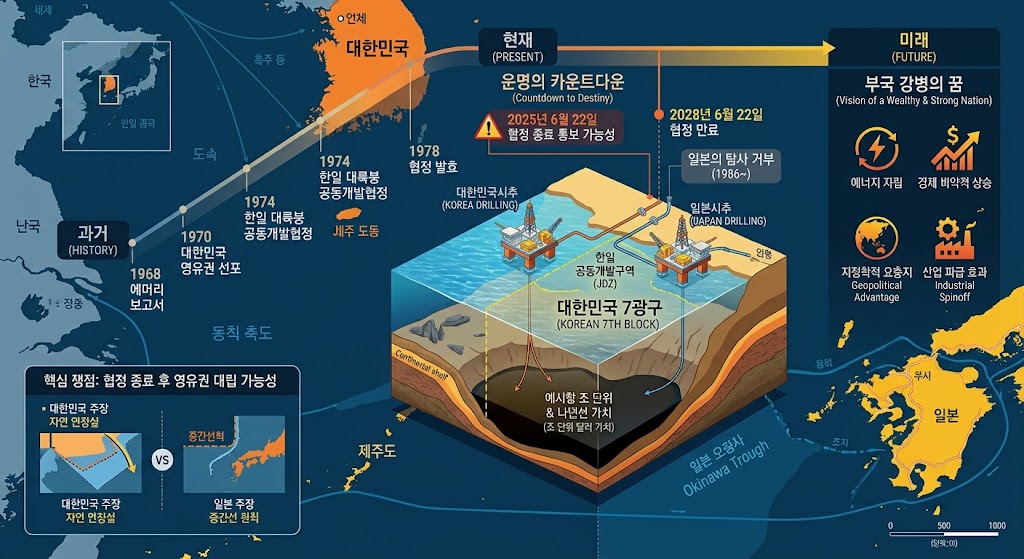
7광구의 역사는 1968년 유엔 아시아극동경제위원회(ECAFE)의 '에머리 보고서'로부터 시작됩니다. 이 보고서는 동중국해 대륙붕에 세계 최대 규모의 석유와 가스가 매장되어 있을 가능성을 제기했습니다.
1970년 영유권 선포: 박정희 정부는 '대륙붕 연장설'을 근거로 7광구를 대한민국 영토로 전격 선포했습니다.
1978년 한일 공동개발협정(JDZ): 일본의 반발로 양국은 50년간 이곳을 공동 개발하기로 약속하며 협정을 발효했습니다.
희망과 좌절: 80년대 초반 시추 결과 일부에서 석유와 가스 징후가 발견되었으나, 일본이 경제성을 이유로 돌연 탐사 중단을 선언하며 7광구는 '잊힌 바다'가 되었습니다.
2. 현재(2026년): 운명의 카운트다운
지금 7광구는 그 어느 때보다 긴박한 상황입니다. 1978년 맺은 50년 기한의 협정이 2028년 6월 22일 만료를 앞두고 있기 때문입니다.
"2025년 6월 22일 이후부터는 한일 양국 중 어느 쪽이라도 협정 종료를 통보할 수 있습니다. 이는 사실상 7광구의 주인이 바뀔 수 있는 법적 서막이 올랐음을 의미합니다."
일본은 협정이 종료된 후, 현대 국제해양법상의 '중간선 원칙'을 내세워 7광구의 대부분을 자국 영해로 편입하려는 전략을 취하고 있습니다. 이에 반해 대한민국은 기존의 '대륙붕 연장설'과 외교적 협상력을 총동원하여 일본을 다시 공동 개발의 장으로 끌어내기 위한 사투를 벌이고 있습니다.
3. 미래: 대한민국 '부국(富國)'으로의 도약
7광구의 성공적인 확보와 개발은 대한민국을 단순한 제조 강국을 넘어 에너지 패권국으로 변모시킬 것입니다.
구분
기대 효과
국가적 의의
에너지 안보
석유·가스 수입 대체
에너지 자립을 통한 무역수지 개선
경제적 부가 가치
수조 달러 가치의 자원 확보
국민 소득 비약적 상승 및 복지 재원 확보
지정학적 영향력
동중국해 해상 주도권 확보
해양 강국으로서의 입지 강화
산업 파급 효과
해양 플랜트 및 조선업 재도약
차세대 에너지 기술 패권 장악
부국강병을 위한 승부수
7광구는 단순한 자원의 보고를 넘어, 대한민국이 강대국들 사이에서 생존하고 번영하기 위한 '전략적 요새'입니다. 우리가 이곳을 지켜내고 자원 추출에 성공한다면, 대한민국은 진정한 의미의 '에너지 주권'을 가진 부국으로 거듭날 것입니다.
4. 결론: 우리 세대의 소명
7광구는 우리 선조들이 발견한 희망이며, 우리 세대가 반드시 지켜내어 후손들에게 물려줘야 할 유산입니다. 2028년까지 남은 시간 동안 치밀한 국제법적 대응, 강력한 외교력, 그리고 온 국민의 관심이 하나로 모여야 합니다. 7광구의 파란 물결 아래 잠든 검은 황금은 대한민국이 세계 중심 국가로 우뚝 서는 촉매제가 될 것입니다.
The Breath of a Tragic King: History and Story of the Danjong Cultural Festival
If one were to choose the most tragic figure in the 500-year history of the Joseon Dynasty, it would undoubtedly be King Danjong, the sixth monarch. The Danjong Cultural Festival, held annually in Yeongwol, Gangwon-do, is more than just a local celebration; it is a profound historical tribute to a young king whose life was cut short and the loyal subjects who refused to forget him.
1. The Tragedy: A 17-Year-Old Boy King's Sorrow
Danjong’s life was defined by premature loss and political betrayal. Ascending the throne in 1452 at the tender age of 12, his reign was quickly undermined by his ambitious uncle, Grand Prince Suyang (later King Sejo).
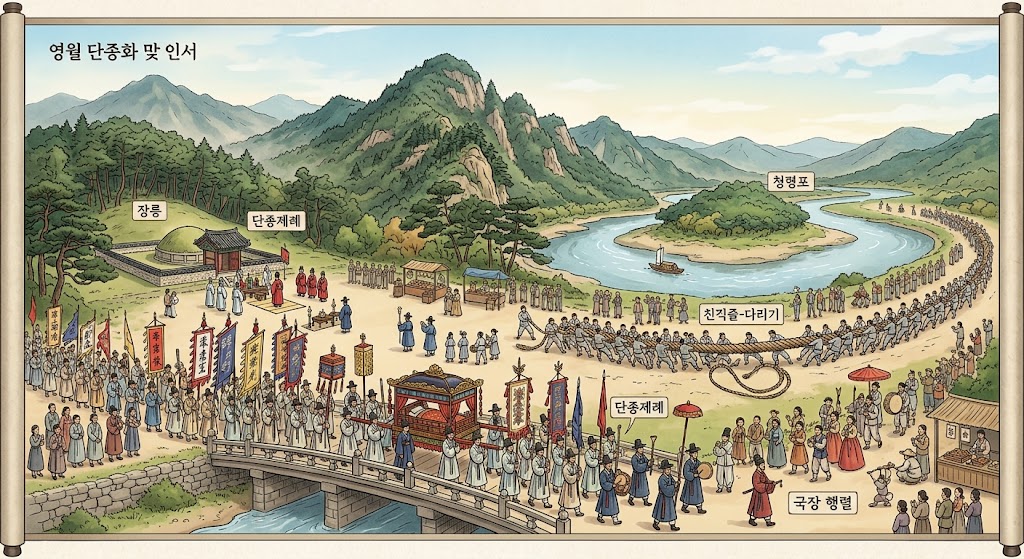
Usurpation and Exile: After being forced to abdicate, Danjong was demoted to "Prince Nosan" and exiled to Cheongnyeongpo in Yeongwol—a place isolated by a deep river on three sides and steep cliffs on the other.
A Lonely End: In 1457, at the age of 17, Danjong was executed by poison. His body was cast into the river, and a grim royal decree warned that anyone who dared to recover the body would see three generations of their family executed.
2. The Origin: The Courage of Uhm Heung-do
While everyone else trembled in fear of the new King Sejo, a local official named Uhm Heung-do stepped forward. Under the cover of night, he recovered the king's body from the river, stating, "It is better to be punished for doing what is right than to live with a guilty conscience."
He secretly buried the king at the site now known as Jangneung. Centuries later, during the reign of King Sukjong, Danjong's royal title was finally restored. To honor his soul, the people of Yeongwol began a tradition of memorial rites, which evolved into the official Danjong Festival in 1967.
3. Festival Highlights: Reclaiming History
The Danjong Cultural Festival is unique for its blend of solemnity and vibrant tradition. It features several key events that cannot be seen anywhere else:
👑 The Royal Funeral Reenactment
Because Danjong died in exile as a demoted prince, he never received a proper royal funeral. Yeongwol residents decided to rectify this 500 years later. This massive procession, involving thousands of participants in traditional attire, serves as a symbolic "final journey" to grant the king the dignity he was denied in life.
🏹 Chikjul-darigi (Kudzu Vine Tug-of-War)
This is a traditional folk game unique to the Yeongwol region. Hundreds of people divide into teams to pull a massive rope made of kudzu vines, symbolizing community unity and a prayer for the repose of Danjong’s soul and the prosperity of the village.
📜 Royal Memorial Rites
Conducted at the Jangneung Royal Tomb (a UNESCO World Heritage site), this ceremony follows strict Joseon court protocols. It is a rare opportunity to witness the authentic Confucian rituals of the royal family.
"The spirit of the young king has become the mountains and rivers of Yeongwol, and the loyalty of the people has blossomed into a cultural legacy that has endured for half a millennium."
4. Why We Remember Danjong Today
The Danjong Cultural Festival is not merely an act of mourning a "sad king." It is a celebration of unwavering loyalty and humanity. It honors those who risked their lives to stay true to their convictions and a community that kept a king's memory alive for 500 years. Every April, as the azaleas bloom in Yeongwol, the story of the boy king is told once again, reminding us of the enduring power of historical memory.
Strategic Analysis: Guyana’s Oil Blocks and South Korea
The rapid development of Guyana’s offshore oil reserves, particularly within the Stabroek Block, has shifted the tectonic plates of global energy geopolitics. For South Korea, a nation that imports nearly all of its energy, Guyana represents more than just a new source of crude; it is a critical node in a broader strategy involving energy security, industrial synergy, and technological diplomacy.
1. Energy Security: Diversification Beyond the Strait of Hormuz
South Korea’s energy strategy has long been haunted by its 70% plus dependency on Middle Eastern oil. Geopolitical volatility in the Persian Gulf makes the Korean economy vulnerable to supply shocks.
Quality and Compatibility: Guyana’s light, sweet crude is highly compatible with South Korea’s sophisticated refining infrastructure, which is optimized for high-value product yield.
Supply Chain Hedge: Establishing long-term off-take agreements or equity stakes in Guyana-Suriname basin blocks provides a vital geographic hedge against disruptions in traditional supply routes.
2. Industrial Synergy: The "Big Three" Shipbuilders
While the oil flows from Guyana, the technology to extract it often flows from Korea. The relationship is a symbiotic industrial loop.
"South Korea does not just buy the oil; it builds the factories that extract it."
FPSO Dominance: The development of Guyana’s deepwater assets relies on Floating Production, Storage, and Offloading (FPSO) units. South Korean giants—HD Hyundai Heavy Industries, Samsung Heavy Industries, and Hanwha Ocean—are the global leaders in this sector.
Infrastructure Export: As Guyana seeks to build out its domestic energy infrastructure, including gas-to-energy pipelines and refineries, Korean EPC (Engineering, Procurement, and Construction) firms are uniquely positioned to win high-value contracts.
3. Comparative Strategic Alignment
Factor
South Korea's Interest
Guyana's Benefit
Capital & Investment
Securing direct equity in oil blocks.
Stable FDI for long-term development projects.
Technology
Exporting FPSO and smart-port tech.
Access to world-class maritime and energy tech.
Geopolitics
Reducing Middle East dependency.
Diversifying international partners beyond the West.
4. Strategic Risks and Challenges
Despite the optimism, the partnership faces significant headwind factors that require careful management:
Geopolitical Friction: The ongoing territorial dispute between Venezuela and Guyana over the Essequibo region introduces a layer of risk for Korean investments.
Logistics: The sheer distance between the Caribbean and East Asia increases transportation costs, though this is mitigated by the sheer volume and quality of the crude.
Energy Transition: South Korea’s 2050 Carbon Neutrality goal creates a paradox: the need for fossil fuel security today versus the long-term shift toward green hydrogen and renewables.
Conclusion: A Multi-Dimensional Partnership
The relationship between South Korea and Guyana is evolving into a strategic alliance of necessity. Guyana provides the raw energy resources South Korea lacks, while South Korea provides the industrial and technological muscle Guyana needs to modernize its economy. In the coming decade, we should expect to see increased diplomatic engagement and a surge in joint ventures between Korean state-run energy companies and the Guyanese government.
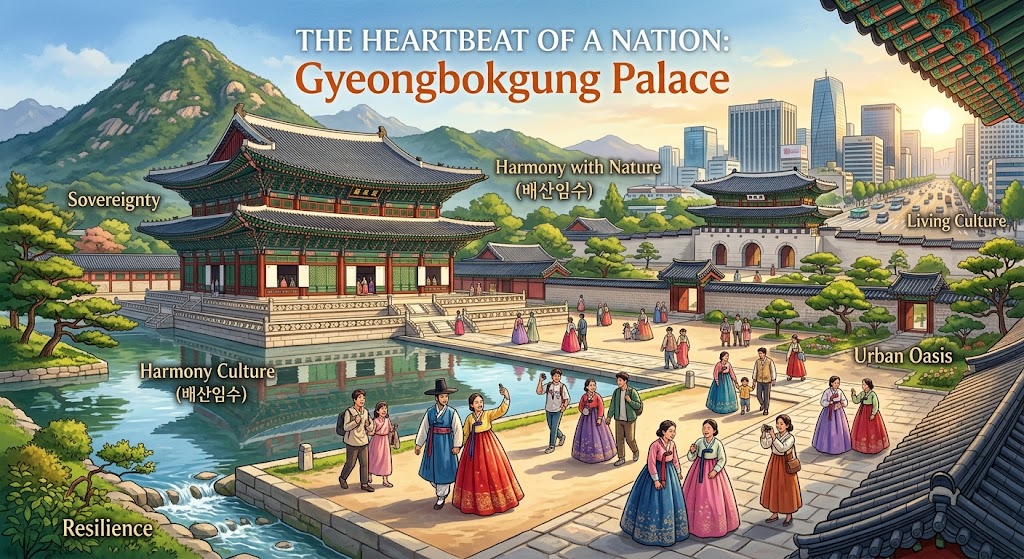
Gyeongbokgung Palace is not just a collection of old buildings; it is the silent witness to the rise, fall, and spectacular rebirth of the Korean spirit. If the stones of this palace could talk, they would tell a story of royal grandeur, tragic fires, colonial scars, and a modern nation’s relentless pursuit of its own identity.
1. The Birth: A Dream of "Great Blessing"
The story begins in 1395, just three years after the founding of the Joseon Dynasty. King Taejo, the first monarch, decided to move the capital to Hanyang (modern-day Seoul). He sought a place with perfect Feng Shui—nestled between the majestic Bugaksan Mountain to the north and the Han River to the south.
The name "Gyeongbokgung" was chosen by the scholar-official Jeong Do-jeon. It translates to "Palace Greatly Blessed by Heaven." It wasn't just a home for the king; it was a physical manifestation of Neo-Confucian ideals: order, harmony, and a deep respect for nature.
2. Architectural Grandeur: Power and Poetics
The layout of Gyeongbokgung is a masterpiece of symmetry and symbolism, designed to reflect the authority of the throne and the beauty of the Korean landscape.
Geunjeongjeon (The Throne Hall): This is the heart of the palace. It is where the king held official audiences and greeted foreign envoys. In the courtyard, "rank stones" mark where officials stood according to their status.
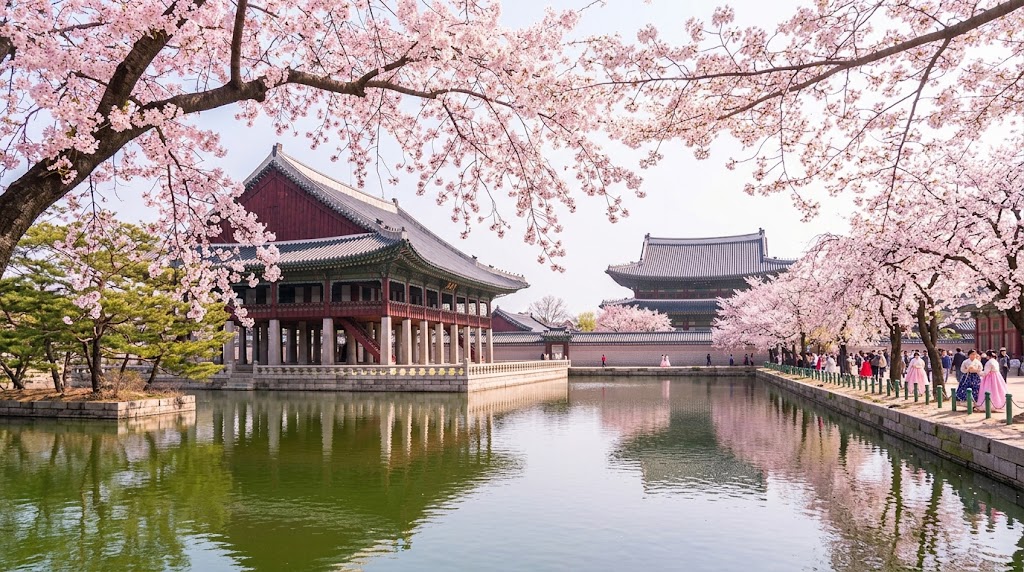
Gyeonghoeru Pavilion: A massive wooden hall that appears to float on a man-made lake. Supported by 48 stone pillars, it was the site of grand royal banquets and remains one of the most photographed spots in Korea.
Hyangwonjeong Pavilion: The king’s private sanctuary—a small, hexagonal pavilion on a lotus pond, representing the "quiet" and introspective side of royal life.
3. The Great Fire and the Long Silence
Gyeongbokgung’s glory was tragically interrupted. In 1592, during the Imjin War (the Japanese invasions), the palace was burned to the ground. For the next 273 years, the palace sat in ruins. The royal family moved to Changdeokgung Palace, and Gyeongbokgung became a ghost of its former self.
It wasn't until the 1860s that the Prince Regent, Heungseon Daewongun, rebuilt it to restore the prestige of the monarchy. Though it nearly bankrupted the government, it restored Gyeongbokgung to its original 7,700-room splendor.
4. The Darkest Hour: The Colonial Era
The late 19th century brought further tragedy. In 1895, Empress Myeongseong was assassinated by foreign agents within the palace walls. When Japan colonized Korea in 1910, they systematically began to dismantle the palace, tearing down over 90% of the buildings.
In an act of symbolic dominance, the Japanese built a massive stone Government-General Building directly in front of the Throne Hall, intentionally blocking the view and disrupting the spiritual flow of the palace grounds.
5. The Modern Renaissance: Rising from the Ashes
The 21st-century story of Gyeongbokgung is one of restoration and pride. In 1995, marking the 50th anniversary of liberation, the government demolished the colonial government building to restore the palace's original profile. Today, a multi-decade project continues to rebuild the corridors and gates using traditional craftsmanship.
"Gyeongbokgung stands as a symbol of resilience. It proves that while buildings can be destroyed, the cultural soul of a people cannot be erased."
Gyeongbokgung Today
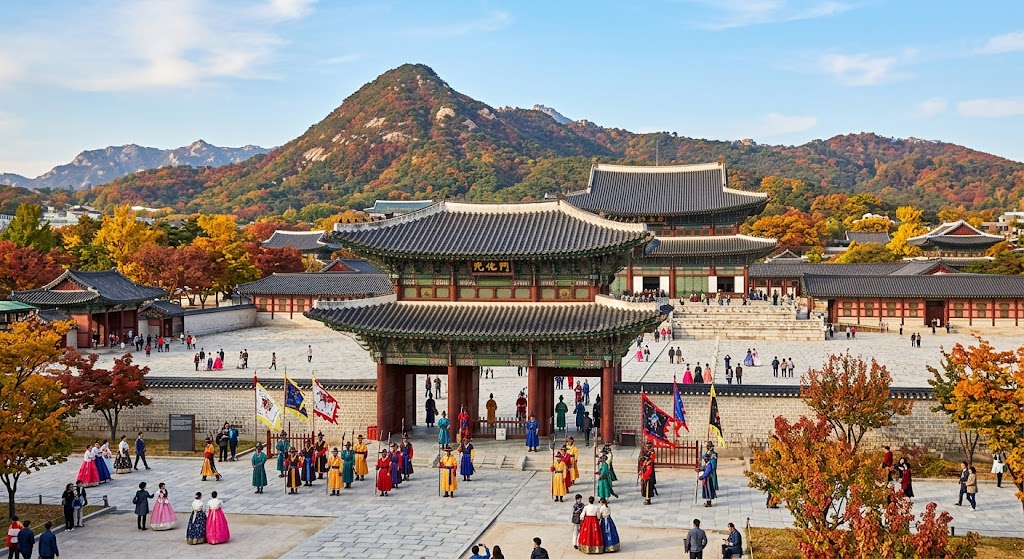
Today, the palace is a vibrant cultural hub. Visitors wearing Hanbok (traditional clothing) enjoy free entry, creating a living bridge between the past and the present. From the Changing of the Guard ceremony to breathtaking night openings, Gyeongbokgung remains the definitive symbol of Korea's royal heritage.
경복궁은 1395년, 태조 이성계가 조선을 건국하고 한양으로 천도하면서 가장 먼저 지은 **조선의 제1법궁(法宮)**입니다. 풍수지리설에 따라 북악산을 뒤에 업고 명당의 자리에 세워진 이 궁궐의 이름은 정도전이 지었으며, 시경(詩經)에 나오는 "군자만년 개이경복(君子萬年 介爾景福)", 즉 '새 왕조가 큰 복을 누리며 영원할 것'이라는 축복을 담고 있습니다.
정전인 근정전을 중심으로 대칭적인 구조를 갖춘 경복궁은 조선 초기의 기틀을 잡는 핵심적인 공간이었습니다. 세종대왕 시절에는 이곳에서 훈민정음이 창제되었으며, 장영실의 자격루와 측우기가 설치되는 등 조선의 과학과 문화가 찬란하게 꽃을 피운 장소이기도 합니다.
2. 수난과 방치, 그리고 대원군의 중건
하지만 경복궁의 역사는 결코 평탄치 않았습니다. 1592년 **임진왜란**이 발발하면서 경복궁은 전소되는 비극을 맞이합니다. 전쟁 후 복구가 시도되었으나 막대한 인력과 예산 문제로 인해 조선 후기 약 270년 동안 경복궁은 폐허로 방치되었습니다. 이 시기 조선의 왕들은 주로 창덕궁을 법궁으로 사용하며 정사를 돌보았습니다.
잠자고 있던 경복궁을 깨운 것은 1865년, 고종의 아버지인 **흥선대원군**이었습니다. 그는 왕실의 권위를 세우기 위해 대대적인 중건 사업을 벌였고, 당시 국내외의 어려운 상황 속에서도 오늘날 우리가 보는 웅장한 궁궐의 모습을 재건해냈습니다. 그러나 이 화려한 복원 역시 얼마 지나지 않아 을미사변과 아관파천이라는 민족적 시련의 배경이 되는 아픔을 겪게 됩니다.
3. 일제강점기의 파괴와 현대의 복원
경복궁의 가장 뼈아픈 역사는 일제강점기에 있었습니다. 일제는 조선의 정통성을 말살하기 위해 경복궁의 전각 90% 이상을 헐어 민간에 매각하거나 파괴했습니다. 궁궐 정면에는 육중한 **조선총독부 청사**를 세워 광화문과 근정전 사이의 맥을 끊어놓기도 했습니다.
"궁궐은 단순한 건물이 아니라 국가의 자존심이자 영혼입니다."
광복 이후 한국인들은 경복궁을 되찾기 위해 노력해왔습니다. 1996년 조선총독부 건물을 철거한 것은 상징적인 사건이었으며, 이후 광화문 제 모습 찾기, 영추문 복원, 최근의 월대 복원까지 이어지며 경복궁은 서서히 그 위엄을 회복하고 있습니다. 현재의 복원 사업은 단순한 수리를 넘어, 뒤틀린 역사를 바로잡는 '치유의 과정'이라 할 수 있습니다.
4. 왜 한국인들은 경복궁을 그토록 사랑하는가?
경복궁은 한국인에게 단순히 '옛날 집' 이상의 의미를 갖습니다. 그 사랑의 이유는 다각적입니다.
첫째, 자연과의 완벽한 조화(Architecture of Harmony)
서구의 궁궐이 인간의 힘을 과시하기 위해 대칭과 화려함에 집중했다면, 경복궁은 뒷산인 북악산과 주변 풍경을 궁궐의 일부로 끌어들이는 **'차경(借景)'**의 미학을 보여줍니다. 경회루 연못에 비치는 인왕산의 모습이나 근정전 너머로 보이는 북악산의 능선은 한국인이 추구하는 '자연스러운 아름다움'의 정수를 보여줍니다.
둘째, 일상으로 들어온 역사 문화
오늘날 경복궁은 박제된 유적지가 아닙니다. 한복을 입고 궁궐을 거니는 MZ세대, 밤의 정취를 느끼기 위한 야간 개장 티켓팅 열풍, 생과방에서 즐기는 다도 체험 등은 한국인들이 역사를 현대적인 놀이문화로 재해석하고 있음을 보여줍니다. 과거의 왕이 걷던 길을 오늘날의 시민들이 한복을 입고 걷는 풍경은 과거와 현재가 소통하는 독특한 장면입니다.
셋째, 꺾이지 않는 민족적 자부심
수많은 파괴와 훼손에도 불구하고 제자리를 지키고 있는 경복궁의 모습은 한국인들의 끈질긴 생명력과 닮아 있습니다. 광화문 앞 넓은 광장에서 열리는 다양한 행사와 시위, 축제들은 경복궁이 여전히 한국 사회의 심장 역할을 하고 있음을 증명합니다. 한국인들은 경복궁을 보며 우리 역사의 찬란했던 순간과 극복의 서사를 동시에 떠올립니다.
5. 마무리하며: 미래를 향한 문
경복궁은 600년의 시간을 버티며 우리에게 말합니다. 역사는 잊혀지는 것이 아니라 현재와 함께 호흡하며 미래로 이어진다는 것을요. 오늘도 광화문의 파수꾼들이 교대 의식을 치르고, 수많은 발길이 근정전 앞마당의 박석을 밟습니다. 이 거대한 공간은 앞으로도 한국인의 정체성을 지켜주는 든든한 버팀목이자, 전 세계 사람들에게 한국의 아름다움을 전하는 가장 큰 창이 될 것입니다.