Cheonggyecheon: Seoul's Blue Vein, Captivating the World

Evolution into a Symbol of Urban Renewal and a Global Travel Essential

In the heart of South Korea’s dynamic capital, Cheonggyecheon Stream flows as a testament to transformative change. Once buried under a dark, concrete elevated highway in the early 2000s, this waterway has redefined Seoul’s identity since its restoration. As of 2026, it stands not just as a restored stream, but as "Seoul’s Living Room"—a must-visit destination for travelers from every corner of the globe.


1. From Gray City to Blue Oasis: The Historical Miracle

The history of Cheonggyecheon mirrors the turbulent modern history of Korea. Following the Korean War, it became a symbol of poverty and pollution, eventually covered in concrete during the 1960s under the banner of "modernization." The massive elevated highway that once sat atop it was a pride of industrialization, but over time, it became an aging eyesore and a source of environmental decay.

The restoration completed in 2005 signaled a massive paradigm shift in urban planning. It marked the transition from an era that sacrificed nature for economic growth to one that prioritizes ecology and quality of life. Today, it acts as the "lungs of the city," lowering urban temperatures and serving as a sanctuary for herons, ducks, and various fish.


2. 3 Reasons Global Travelers are Wild About Cheonggyecheon

According to 2026 travel trends, Cheonggyecheon ranks alongside Gyeongbokgung Palace and Myeong-dong as a top Seoul attraction. Here is why the world is falling in love with it:

① The Essence of 'K-Healing'

For those used to the frantic pace of NYC, London, or Tokyo, Seoul can feel incredibly fast. However, the moment you step down into the Cheonggyecheon walkway, the city noise miraculously fades away. Travelers call it an "Urban Sanctuary." Simply listening to the sound of flowing water—a practice Koreans call "Mul-meong"—is rated as the ultimate relaxation during a busy travel itinerary.

② A Visual Intersection of Past and Future

Walking the stream allows you to see the Gwangtonggyo Bridge (from the Joseon Dynasty) set against a backdrop of ultra-modern glass skyscrapers. This contrast provides a visceral understanding of Korea's unique harmony between tradition and modernity. At night, the reflection of neon lights on the water creates a "Cyberpunk" aesthetic that is a dream for photographers and social media creators.

③ The Stepping Stone Experience

The "Stepping Stones" (Jinggeom-dari) are a novel feature rarely seen in Western urban rivers. Crossing the stream by hopping from stone to stone has become a viral sensation on Instagram and TikTok, offering a tactile way for tourists to engage with the city’s landscape rather than just observing it from afar.


3. New 2026 Tour Trends: More Than Just a Walk

The "Cheonggyecheon experience" has evolved into a sophisticated cultural circuit integrated with technology and local subcultures.

  • HiKR Ground Synergy: Located at the stream's starting point, this K-tourism hub uses K-Pop and media art to draw in Gen Z travelers before they begin their walk.
  • The 'Hip-jiro' Connection: The lower part of the stream connects to Euljiro (nicknamed 'Hip-jiro'). It has become standard for tourists to enjoy a nature walk during the day and dive into the "authentic Korea" vibe of Euljiro’s hidden bars and old-school eateries at night.
  • Smart Tourism Tech: AR (Augmented Reality) guides are now placed throughout the path, allowing visitors to see through their phones what the area looked like 100 years ago or during its industrial "covered" phase.

4. A Global Role Model for Urban Renewal

"Cheonggyecheon is a powerful message to urban planners worldwide on how nature and humanity can coexist in a high-density environment."
- Common consensus among international urban engineering experts.

Cheonggyecheon is now more than a tourist spot; it is a classroom. In an era of climate crisis, its success in cooling city temperatures and providing green space is being benchmarked by city governments from Paris to New York.

💡 The Perfect "Half-Day" Course

Maximize your experience with this curated route:

  • Start: 4:00 PM at Cheonggye Plaza (the iconic purple spiral sculpture).
  • Experience: Walk past Gwangtonggyo Bridge and try the Stepping Stones for a photo op.
  • Break: Visit a terrace cafe overlooking the water for some K-desserts.
  • Finish: Walk toward DDP (Dongdaemun Design Plaza) to witness the spectacular night lights and do some late-night shopping.

Conclusion: An Echo of Coexistence

Cheonggyecheon is no longer just a waterway; it is a brand that leaves a lasting impression on the hearts of global visitors. It proves that "Sustainability" and "People-centric design" are the most beautiful ways to build a city.

In 2026, the stream continues to flow, carrying with it Korea’s history, the curiosity of world travelers, and the peaceful leisure of a global metropolis. Its popularity is not just a trend; it is a deep, steady flow that will only grow stronger with time.

© 2026 Seoul Travel Insight. All Rights Reserved.

삼성전자 노사 갈등의 쟁점과 미래 경쟁력 전망

[개요] 본 보고서는 삼성전자 노동조합의 요구사항이 기업 경영에 미치는 실질적인 리스크를 분석하고, 인공지능(AI) 반도체 전쟁이라는 급변하는 환경 속에서 삼성전자가 직면한 도전과 기술적 도약 가능성을 입체적으로 조망합니다.

1. 삼성노조 요구의 핵심 내용과 무리한 지점

최근 전국삼성전자노동조합(전삼노)은 창사 이래 첫 파업을 단행하며 높은 수준의 보상과 제도 개선을 요구하고 있습니다. 그러나 업계 전문가들은 다음과 같은 이유로 노조의 요구가 기업의 기초 체력을 저해할 수 있다고 지적합니다.

1.1. 산업 사이클을 무시한 고정비 증가 요구

반도체 산업은 소위 '붕어빵'을 찍어내듯 일정한 수익이 나는 구조가 아니라, 수조 원의 적자와 흑자를 오가는 극심한 사이클 산업입니다. 노조가 요구하는 높은 기본급 인상률과 고정적 성과급 산정 방식은 업황이 악화되었을 때 기업의 재무적 유연성을 마비시킬 위험이 큽니다. 이는 경쟁사들이 불황기에 연구개발(R&D)에 집중할 때 삼성은 인건비 압박에 시달리게 만드는 결과를 초래할 수 있습니다.

1.2. 성과주의(Meritocracy) 시스템의 붕괴 우려

삼성전자를 글로벌 1위로 만든 원동력은 "성과가 있는 곳에 파격적인 보상이 있다"는 원칙이었습니다. 그러나 노조는 영업이익을 기준으로 모든 직원에게 균등하게 성과급을 배분할 것을 요구하고 있습니다. 이는 치열한 기술 경쟁 현장에서 밤낮없이 연구하는 핵심 엔지니어들의 사기를 꺾고, 조직 전반의 하향 평준화를 불러올 가능성이 큽니다.

2. 노사 갈등 장기화에 따른 경영 리스크 분석

구분 주요 리스크 내용 파급 효과
운영 측면 생산 라인 가동 중단 및 수율 저하 납기 지연으로 인한 글로벌 고객사 이탈
인적 측면 핵심 설계 인력의 경쟁사 이직 가속화 기술 초격차 유지 불가능 (HBM, 파운드리)
대외 측면 브랜드 가치 하락 및 투자 심리 위축 주가 저평가(Korea Discount) 심화

3. 미래 삼성의 전망: 위기와 기회의 분수령

현재 삼성전자는 '샌드위치' 위기에 처해 있습니다. 메모리에서는 SK하이닉스의 추격을, 파운드리에서는 TSMC와의 격차를 줄여야 하는 상황입니다. 하지만 향후 2~3년 내의 대응에 따라 재도약의 기회는 충분합니다.

3.1. 반도체(DS) 부문: HBM4와 2나노 공정의 승부수

삼성은 현재 HBM3E 시장의 검증을 마무리하고, 차세대 HBM4(6세대) 시장에서 주도권을 잡기 위해 총력을 다하고 있습니다. 특히 삼성은 메모리와 파운드리, 첨단 패키징 기술을 모두 보유한 세계 유일의 기업으로, AI 가속기를 제작하려는 빅테크 기업들에게 '원스톱 솔루션'을 제공할 수 있는 강력한 잠재력을 가지고 있습니다.

3.2. 파운드리 부문: GAA 기술의 성숙도 확보

TSMC를 넘어서기 위해 삼성은 세계 최초로 GAA(Gate-All-Around) 구조를 3나노 공정에 도입했습니다. 2025년 양산 예정인 2나노 공정에서 안정적인 수율을 확보한다면, 전력 효율을 중시하는 AI 칩 설계 기업들의 대규모 수주를 이끌어낼 수 있을 것으로 전망됩니다.

4. 지속 가능한 성장을 위한 제언

삼성전자가 현재의 위기를 돌파하기 위해서는 노사 양측의 패러다임 전환이 절실합니다.

  • 노조의 책임 경영 참여: 단순한 임금 인상 투쟁에서 벗어나, 회사의 중장기 경쟁력 강화를 위한 생산성 향상 방안을 함께 고민해야 합니다.
  • 경영진의 투명한 소통: 성과급 산정 기준 등 민감한 이슈에 대해 직원들이 납득할 수 있는 데이터와 비전을 제시하여 내부 불만을 해소해야 합니다.
  • 유연한 조직 문화로의 회귀: 관료주의를 타파하고 엔지니어가 존중받는 문화를 복원하여, 인재들이 삼성에서 꿈을 펼칠 수 있는 환경을 조성해야 합니다.

5. 종합 결론

삼성전자의 미래는 단순히 기술력 하나로 결정되지 않습니다. 내부의 결집된 힘이 뒷받침될 때 비로소 기술 초격차도 의미가 있습니다. 현재의 노사 갈등은 삼성이 '뉴 삼성'으로 거듭나기 위한 일종의 성장통일 수 있습니다. 하지만 이 통증이 장기화되어 골든타임을 놓친다면, 글로벌 반도체 패권 경쟁에서 낙오될 수 있다는 위기감을 노사 모두가 공유해야 합니다.

결국 2026년 이후 삼성의 모습은 현재의 갈등을 어떻게 '상생의 에너지'로 전환하느냐에 달려 있습니다. 기술 혁신의 속도가 인건비 상승과 내부 갈등의 비용을 압도할 때, 삼성은 다시 한번 글로벌 시장의 지배자로 우뚝 설 것입니다.

Guardians of the Ridge:
The Legacy and Future of Korean Mountain Fortresses

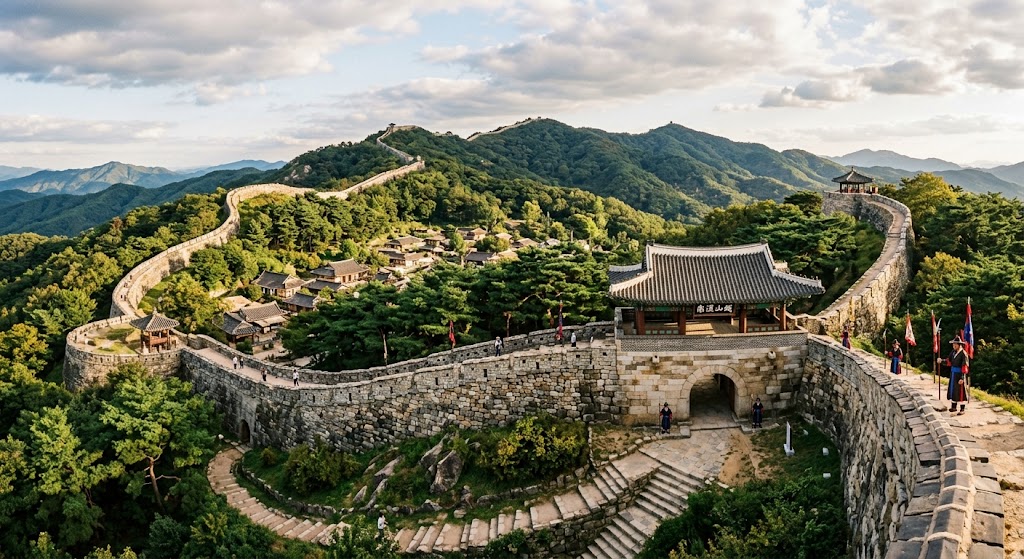
Korea is a land where mountains comprise over 70% of the territory. For millennia, these granite peaks were not just scenic backdrops but the very backbone of national survival. The Sanseong (Mountain Fortress) represents a unique defensive philosophy known as "Ipsan Suseong" (Entering the mountains to defend the castle). Unlike the massive walled cities of the plains found in China or Europe, Korean fortresses were built atop rugged ridges to leverage natural terrain as an impenetrable shield.

1. The Scientific Architecture of Sanseong

Korean mountain fortresses were masterpieces of engineering, designed to maximize defensive efficiency with minimal manpower. Their structures were evolved to counter specific siege tactics while preserving the lives of both soldiers and civilians.

Key Structural Elements

  • Chi (Bastion): Rectangular projections from the main wall. These allowed defenders to strike the flanks of enemies attempting to scale the walls, eliminating "blind spots."
  • Ongseong (Barbican): A secondary curved wall protecting the main gate. It forced attackers into a narrow "killing zone" where they could be showered with projectiles from three sides.
  • Yeojang (Parapet): Low battlements atop the wall with embrasures (holes) specifically angled for archers or musketeers to fire while remaining undercover.
  • Guraengi Construction: A sophisticated technique where natural stones were meticulously carved to fit the irregular surfaces of foundation rocks, creating a "Lego-like" interlocking bond that resisted earthquakes and heavy rain.

2. A Chronicle of Resilience: Historical Evolution

The history of Korean fortresses is a timeline of innovation born from necessity. From the iron-willed expansion of the Three Kingdoms to the scientific advancements of the late Joseon Dynasty, each era left its mark on the stone walls.

Historical Era Core Philosophy & Strategy Notable Examples
Three Kingdoms (Goguryeo, Baekje, Silla) Foundational stone-stacking techniques; fortresses acted as offensive bases for territorial expansion. Achasanseong, Gongsanseong, Samnyeonsanseong
Goryeo Dynasty Resistance against nomadic invasions (Khitan, Mongol). Fortresses became temporary capitals for the royal court. Ganghwa Jungseong, Jukjusanseong
Joseon Dynasty Systemization of defense after the Imjin War. Introduction of brickwork and firearms-oriented design. Namhansanseong, Bukhansanseong, Hwaseong (Suwon)
"The fortress is like the shoes of a nation. Just as shoes protect the feet on rough paths, the Sanseong protected the people through the rough paths of history."

The Pinnacle: Suwon Hwaseong

In the late 18th century, King Jeongjo oversaw the construction of Suwon Hwaseong. This fortress was a synthesis of traditional Korean mountain defense and Western military science. Utilizing cranes (Geojunggi) and reinforced bricks, Hwaseong featured an unprecedented level of defensive depth, earning its place as a UNESCO World Heritage site and the crown jewel of Oriental fortress architecture.

3. The Future: From Barriers to Bridges

As the drums of war faded, the Sanseong transitioned into a cultural and spiritual asset. The future of these fortresses lies in their transformation into Smart Heritage and global cultural landmarks.

Digital Reconstruction & Metaverse

Many ancient fortresses, particularly those of the Goguryeo era, currently lie in ruins or are inaccessible. The future utilizes Digital Twin technology to reconstruct these sites in virtual spaces. AR (Augmented Reality) allows modern hikers to look through their smartphones and see the 5th-century battlements rise from the overgrown ridges, bridging the gap between history and the 21st century.

Ecological and Healing Spaces

Korean mountain fortresses are increasingly recognized for their "Bio-Heritage" value. Since they were built along natural ridges, they preserve old-growth forests and biodiversity. The future "Sanseong Trails" are being developed as paths for mental healing, where citizens can walk the same paths as their ancestors, finding peace in the very places that once stood at the center of survival.

K-Heritage on the Global Stage

Following the global success of Korean content, the "Sanseong" is becoming a destination for global travelers seeking authenticity. Future management focuses on storytelling—narrating the tales of the commoners who carried the stones—ensuring that these stone walls are seen not just as military relics, but as monuments to human endurance and community spirit.


A Symphony of Light and Petals

Yeouido Cherry Blossom Night Festival 2026

Midnight Blooms by the Han River

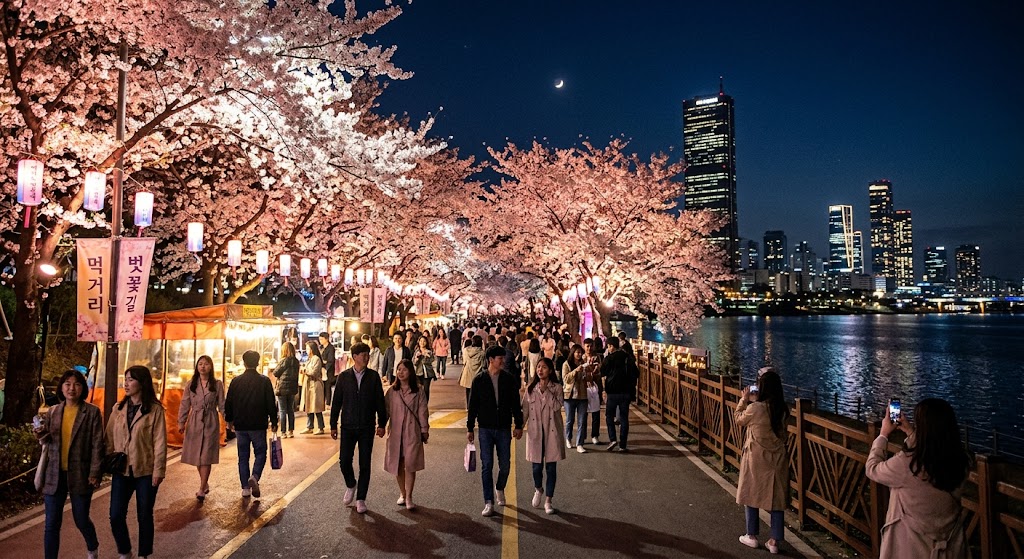
As the sun sets over the Seoul skyline, the Yeouiseo-ro (Yunjung-ro) transforms into a celestial tunnel. Thousands of cherry trees are illuminated by multicolored LED spotlights, casting a dreamlike glow on the delicate white and pink petals.

The Atmosphere: The cool river breeze carries the faint scent of spring, while the distant lights of the IFC Mall and the 63 Building provide a dramatic urban backdrop to the soft, organic beauty of the blossoms.

Visual Highlights

  • Illuminated Canopy: The lights change colors—from soft lavender to warm gold—creating a different mood every few minutes.
  • River Reflections: The view from the Yeouido Hangang Park offers a stunning reflection of the blossoms and city lights on the water's surface.
  • Street Performances: Buskers and acoustic musicians line the path, their melodies blending perfectly with the falling "flower snow."

Visitor Guide for Late April

While the peak of the blossoms typically occurs in early April, the night festival atmosphere remains the highlight of the season. Here is how to make the most of your visit:

  • The Golden Hour: Arrive around 6:30 PM to witness the transition from the "Blue Hour" to the full night illumination.
  • Transport: Use National Assembly Station (Line 9) or Yeouinaru Station (Line 5). Avoid driving as roads are often pedestrian-only during this period.
  • Dress Code: Even in mid-April, the riverfront can be chilly at night. A light jacket or a stylish trench coat is highly recommended.
  • Photography: Night mode on modern smartphones works wonders here. Try to capture the contrast between the dark sky and the glowing petals.

Yeouido Spring Night Guide | Updated April 15, 2026

Enjoy the ethereal beauty of Seoul's most iconic spring night.

```

The Strategic Significance of NATO's 30-Ambassador Delegation to South Korea

In April 2026, the visit of the North Atlantic Council (NAC)—comprising ambassadors from all 30 NATO member nations—to South Korea represents a tectonic shift in the global security architecture. This mission transcends traditional diplomacy, signaling the birth of a deeply integrated security partnership between the Euro-Atlantic and the Indo-Pacific regions.


1. Core Strategic Implications

I. Connectivity of Regional Security

The visit underscores the reality that security in Europe and Asia is no longer divisible. In the face of the Russia-North Korea military nexus, NATO’s presence in Seoul serves as a definitive statement: "Any threat to the stability of the Indo-Pacific is a direct concern for the Atlantic Alliance."

II. Validation of the 'K-Defense' Powerhouse

With European defense stockpiles under pressure, South Korea’s industrial capacity has become a strategic asset for NATO. The delegation’s tour of facilities like Hanwha Aerospace was a practical assessment of South Korea's ability to provide K2 Black Panther tanks, K9 Howitzers, and KF-21 fighters that meet NATO’s rigorous interoperability standards with unmatched delivery speed.

III. Strengthening Collective Deterrence

The unified presence of 30 ambassadors acts as a high-level psychological deterrent against North Korean provocations, demonstrating that South Korea’s support network now extends formally to the world's most powerful military alliance.


2. Future Outlook: Areas of Institutionalized Cooperation

Sector Strategic Objective Anticipated Outcome
Defense Industry Joint production and MRO (Maintenance, Repair, Overhaul) hubs in Europe. Strategic supply chain resilience and dominant market share in EU.
Cyber Defense Active participation in the NATO CCDCOE and real-time threat intelligence. Immunity against state-sponsored hacking and hybrid warfare.
Space & AI Collaborative satellite surveillance and AI-driven ethical military standards. Technological superiority in multi-domain operations.
Maritime Security Joint naval exercises and freedom of navigation advocacy. Stable global trade routes and Indo-Pacific stability.
Expert Analysis: The transition from a "Global Partner" to an ITPP (Individually Tailored Partnership Programme) framework allows South Korea to act as a bridge between NATO’s technological requirements and the Indo-Pacific’s operational realities. For South Korea, this is the ultimate validation of its "Global Pivotal State" doctrine.

3. Key Platforms Driving the Partnership

  • K2 Black Panther: Poised to become a standard main battle tank for several NATO members due to its immediate availability and performance against modern threats.
  • KF-21 Boramae: Viewed as a critical 4.5/5th-generation solution that offers an optimal balance of cost and capability for European air forces looking to diversify from F-35 dependencies.
  • Bio-Defense & Medical Tech: Leveraging South Korea's advanced medical infrastructure to cooperate on military medicine and pandemic-scale security threats.

Ultimately, the visit of 30 NATO ambassadors to South Korea in 2026 marks the moment when Seoul became a "de facto" security pillar for the Western world. This partnership will continue to evolve into a comprehensive alliance covering technology, industry, and shared democratic values.

© 2026 Strategic Intelligence Report. All rights reserved.

Hyunmoo-V (현무-5): The Apex of Strategic Deterrence

Republic of Korea's Indigenously Developed, World's Most Powerful Non-Nuclear Penetration Ballistic Missile

Strategic Summary: The Hyunmoo-V is a "heavyweight ballistic missile" designed specifically to precision-strike North Korea's deeply buried, hardened underground facilities. It is evaluated as the most powerful conventional deterrent available to a non-nuclear state, significantly impacting the military balance in Northeast Asia.

1. Unrivaled Technological Power

Warhead Weight 8-9 Tons (World's Largest). Possesses overwhelmingly superior destructive energy compared to existing conventional missiles.
Penetration Capability Can penetrate over 100 meters of reinforced concrete and rock, neutralizing underground facilities.
Terminal Velocity Descends at a speed of over Mach 10 in the terminal phase, making interception extremely difficult.
Strategic Versatility By adjusting the warhead weight, the range can be extended by thousands of kilometers, allowing operation in the Intermediate-Range Ballistic Missile (IRBM) class.
Physical Destructive Power: Beyond the explosive power itself, the massive kinetic energy generated by the heavy warhead's impact creates artificial seismic waves that collapse surrounding underground structures. This provides, in effect, a psychological and physical pressure equivalent to a "tactical nuclear" weapon.

2. International Community and Regional Reactions

🇺🇸 USA & West

They analyze that "South Korea's missile technology has crossed the threshold." Military experts are stunned that a non-nuclear state can successfully operate a heavy-payload warhead of this level, highly evaluating South Korea's autonomous defense capability.

🇨🇳 China

China is extremely sensitive to the Hyunmoo-V's extended-range capability. It considers the missile as a strategic threat capable of bringing its entire territory within range, and raises voices of caution against South Korea's military build-up.

🇯🇵 Japan

Japan pays close attention to South Korea's precision-strike capability and uses it as a case study to justify its own "counterstrike capability." On the other hand, there is a perceptible sense of unease that South Korea's missile arsenal is already outpacing Japan's.

🇰🇵 North Korea

It poses a direct existential threat to North Korea's deeply concealed leadership. The massive warhead, using a vertical descent approach that is virtually impossible for any current air defense system to stop, serves as a practical counterparty to North Korea's asymmetric capabilities.

3. Conclusion: Strategic Implications

The deployment of the Hyunmoo-V signifies that the Republic of Korea no longer relies solely on the nuclear umbrella of its allies, but possesses the capability to establish an autonomous 'balance of terror'. This will serve as a key asset that amplifies South Korea's diplomatic and military voice in future regional dynamic shifts.

The Epic of Korean Cherry Blossoms: Historical Turbulence and Cultural Blooming

"Beyond being a mere messenger of the changing seasons, the cherry blossom has become an icon representing the pain and triumph of modern Korean history and the peak of its vibrant popular culture. We explore the deep-rooted emotions and narratives hidden within the pale pink petals that bloom after enduring the harshest winters."

1. Deep Roots and Identity: The Origin of the King Cherry

The perception of cherry blossoms in Korea has long been a complex intersection of love and historical resentment. In the distant past, cherry trees were not merely ornamental. Records from the Goryeo and Joseon dynasties reveal that cherry wood (specifically from wild mountain varieties) was highly valued for its durability and elasticity. It was a critical military resource used for crafting traditional Korean bows and was also utilized in creating woodblocks for printing, such as the Tripitaka Koreana.

In modern times, the most significant turning point was the scientific discovery regarding the King Cherry Tree (Prunus yedoensis). In 1908, a French missionary named Father Taquet discovered a natural habitat of King Cherry trees on the northern slopes of Mt. Halla on Jeju Island. This provided scientific evidence that the origin of this specific variety, often associated solely with Japan, could be traced back to the Korean Peninsula. This discovery allowed Koreans to re-embrace the flower not as a symbol of occupation, but as a part of their own natural heritage.

2. Scars of the Past: The Changgyeongwon Era

The popularization of "flower viewing" in Korea is ironically linked to a painful chapter of the Japanese colonial period. To degrade the authority of the Joseon Dynasty, the colonial government converted Changgyeonggung Palace into a zoo and botanical garden, planting thousands of cherry trees and renaming it 'Changgyeongwon.'

While Changgyeongwon became a major destination for city dwellers, the cherry trees were viewed with hostility following liberation in 1945. Many were cut down as "remnants of imperialism." It wasn't until the 1980s, through the "Changgyeonggung Restoration Project," that the palace was returned to its original royal state. The cherry trees were relocated, and the blossom finally evolved from a tool of cultural suppression into an object of pure aesthetic appreciation.

3. The Rise of Korean Localism: Jinhae to Yeouido

The widespread presence of cherry blossoms across the nation today is largely due to the reforestation projects of the 1960s and 70s. Certain locations have since become legendary:

  • Jinhae Gunhangje: Originally a memorial service for Admiral Yi Sun-sin, this festival in the naval port of Jinhae has grown into a world-class event where 360,000 King Cherry trees bloom simultaneously.
  • Yeouido Yeouiseo-ro: Located behind the National Assembly in Seoul, this cherry blossom tunnel offers an urban escape and a symbol of spring for city workers.
  • Gyeongju Bomun Complex: The blossoms here blend with the ancient architecture of the Silla Kingdom, creating a unique atmosphere that bridges history and nature.

4. The Modern 'Cherry Blossom Fever': A Cultural Phenomenon

For modern Koreans, the blooming of cherry blossoms is a collective annual ritual. The proliferation of smartphones and social media has fueled a craze for capturing the perfect "life-shot," turning a simple walk into a shared cultural experience.

A Season Defined by Music: 'Cherry Blossom Ending'

The 2012 hit song "Cherry Blossom Ending" by Busker Busker changed how Koreans experience spring. The song re-enters the music charts every single year when the first buds appear, earning the nicknames "Cherry Blossom Zombie" (because it keeps coming back to life) and "Cherry Blossom Pension" (providing steady royalties to the artist). It has become a cultural trigger; when the melody is heard on the streets, people know that spring has truly arrived.

The Aesthetics of the Ephemeral

The intense passion Koreans have for cherry blossoms stems from their fleeting nature. The flowers reach full bloom and vanish within a week, often ending in a "flower rain" (Kkot-bi) where petals fall like snow. This resonates with the traditional East Asian sentiment that beauty is most precious when it is temporary. It drives a dynamic culture of real-time bloom tracking and nighttime viewings to catch the peak moment.

5. Conclusion: A Flower of Resilience and Coexistence

Korean cherry blossoms have endured 100 years of turbulent history. Moving past a painful past where they were forced upon the landscape, they have reclaimed their identity through scientific discovery and public affection.

Today, the laughter of people gathered under the pink canopy reflects the resilience of the Korean spirit—healing past wounds and celebrating the present. The fluttering petals are no longer a foreign sight, but the most authentic face of spring in Korea.

© 2026 Korean Culture & History Series - The Herald of Spring: Cherry Blossoms

```

The Statue of Peace

A Monument of Remembrance, Justice, and Our Shared Future

1. Introduction: More Than Just Bronze

In front of the former Japanese Embassy in Seoul stands a bronze statue of a young girl. Known officially as the "Statue of Peace" (Pyeonghwa-ui Sonyeosang), she sits quietly, yet her presence speaks volumes. First erected on December 14, 2011, to mark the 1,000th Wednesday Demonstration for the "Comfort Women" victims of the Japanese military, this statue has evolved from a local memorial into a global icon for human rights.

As we navigate the complexities of the 21st century, the Statue of Peace serves as a bridge between a painful past and an aspirational future. To understand its role in a future society, one must first decipher the silent language of its design and the universal values it champions.

2. Decoding the Symbolism: A Silent Testimony

Every detail of the statue, crafted by artists Kim Seo-kyung and Kim Eun-sung, is meticulously designed to represent the historical reality and the unyielding spirit of the victims.

Symbolic Element Visual Representation Philosophical Meaning
Roughly Cut Hair Jagged, uneven bob cut Represents the forced severance from family and hometown; the loss of one's youth and identity.
The Small Bird Perched on the shoulder A messenger of peace and a bridge between the deceased victims and the current generation.
Raised Heels Bare feet not touching the ground Symbolizes the lack of a "place to belong" even after returning home, due to social stigma and government neglect.
Clenched Fists Hands resting on the lap A manifestation of the firm resolve to receive a sincere apology and achieve historical justice.
The Empty Chair A vacant seat next to the girl Represents the victims who have passed away and an invitation for the public to sit and engage in empathy.

Furthermore, the Shadow of an Old Woman engraved on the pedestal reminds us that while the crime was committed against young girls, the pain lasted a lifetime. The white butterfly within that shadow symbolizes "Rebirth"—the hope that the souls of the victims may find the freedom in the afterlife that they were denied in youth.

3. The Statue’s Vision for a Future Society

The significance of the Statue of Peace is not confined to the history of the 20th century. It offers a blueprint for the ethical foundations of the society we are building today.

A Global Standard for Women's Human Rights

In a future society where global integration continues, the statue serves as a universal warning against wartime sexual violence. It transcends nationalism and ethnic boundaries, standing as a guardian for the dignity of women in all conflict zones—from the past in East Asia to current crises across the globe. It demands that the "future" must be a space where the physical and psychological integrity of every individual is protected by international law and collective conscience.

The Power of Collective Memory in a Digital Age

As we move toward a highly digitized future, the risk of "historical amnesia" grows. The Statue of Peace acts as a physical anchor in a virtual world. It teaches future generations that remembrance is an active form of justice. By remembering the victims, society ensures that the structural violence of the past cannot be easily replicated under new guises.

Fostering "Active Peace" Over "Passive Silence"

The statue does not look down in shame; she looks forward with a clear, steady gaze. This represents a shift from "passive peace" (the mere absence of war) to "active peace" (the presence of justice and truth). A future society inspired by this image is one where citizens are encouraged to speak out against injustice, even when it is uncomfortable or politically sensitive.

4. Ethical Responsibility in a Technological Era

As Artificial Intelligence and robotics redefine what it means to be human, the Statue of Peace refocuses our attention on the irreplaceable value of human suffering and empathy. While machines can process data, only humans can bear witness.

"Those who cannot remember the past are condemned to repeat it." – George Santayana

The "Empty Chair" next to the statue is perhaps the most significant element for the future. It is a space for dialogue. In the future, this chair will be filled by students, activists, and world leaders who must sit beside the history of the "Comfort Women" to find the wisdom necessary to prevent future atrocities.

5. Conclusion: Carrying the Torch of Truth

The Statue of Peace is far more than a monument to the victims of the Japanese military's sexual slavery. It is a living testament to the resilience of the human spirit and a constant reminder that true peace is built on the foundation of truth, not the convenience of silence.

In the future society, the statue will continue to serve as a compass. It tells us that progress is not measured solely by technological advancement or economic growth, but by how well we protect the most vulnerable and how honestly we confront our own histories. By sitting in the empty chair, we promise to be the voice for those who were silenced, ensuring that the light of human rights never fades in the coming centuries.

© 2026 Institute for History and Future | All Rights Reserved.

Dedicated to the victims of wartime sexual slavery and the pursuit of global peace.

+ Recent posts